Guest blog by: Hannah Spink, Highly Specialised Physiotherapist, Bumble Bee Physiotherapy
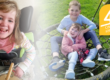
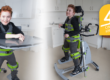
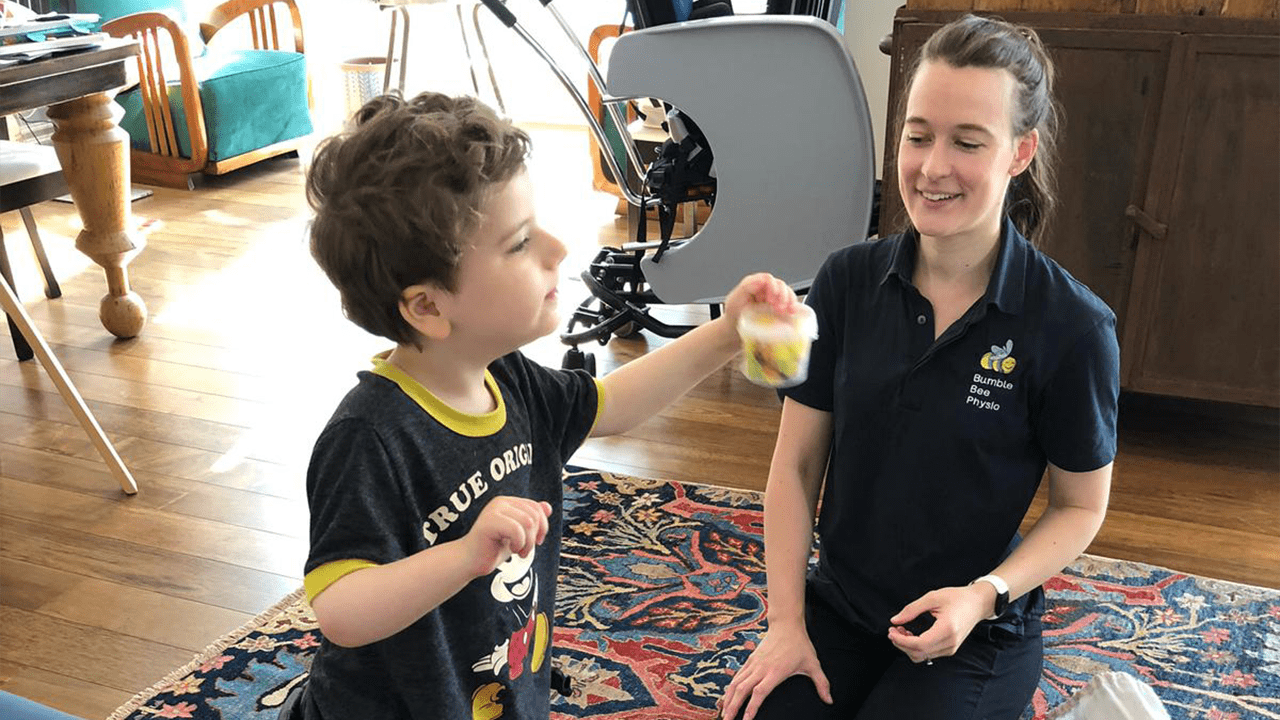
6 year old Henry was the hardest working, most determined and smiley little guy we have ever met at Bumble Bee Physio! He had a diagnosis of Rett Syndrome, which comes with an extremely high likelihood of scoliosis. Henry had very low muscle tone, and took part in daily physiotherapy with his family and therapists, which he absolutely loved. His favourite activity was to choose items to put in a box, when actively standing in the Rifton Pacer.
Jenx’s UK division, Jiraffe are also Rifton’s exclusive UK distributor, and thanks to their loan scheme, Henry first trialled the Rifton Pacer walker in 2018. At the trial, he was placed in the walker and he sat on the saddle without weight bearing. In bare feet, despite all of the encouragement in the world, he did not have a flicker of movement in his feet or legs. Hannah, his physiotherapist, did not think this was an issue, and believed he had potential to learn to step and walk. This is because Henry has learned many skills in the past, and just needed time and patience.
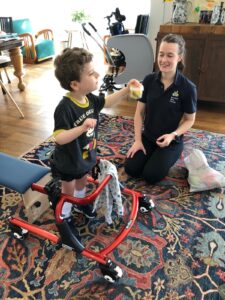
Henry loaned the walker using Jiraffe’s rental programme (Emergency Posture Provision). He first went in the walker with the full support of the saddle, the chest prompt and the arm handles. The saddle and chest prompt were adjusted on a forwards tilt, to break down the steps required to propel the walker, and do the ‘pushing’ part for him. This way, if Henry ever stepped, the walker would naturally move forwards. Henry had toys, balls, sensory objects and water under his feet to encourage movement. He started moving his legs and exploring the objects very quickly! He would be encouraged to walk with passive movements to his favourite toys. However, he could not reach them due to the bulk of the walker in front of him. The walker was turned around so Henry had nothing in front of him. Within a few days, Henry started stepping with both legs together (bunny hopping) and propelling the walker independently. He was not yet bearing weight, and was on a significant forwards tilt. Over the next few weeks, Henry was passively assisted to step reciprocally with ‘one, two’ verbal prompts repeated. He then learned to do this and propel the walker independently with bare feet.
Over the next few months, Henry had his foot support increased from lightweight trainers, to AFOs, to AFOs and footwear.
When he was confidently stepping reciprocally in AFOs and shoes, and propelling the walker independently consistently, the support was changed to a more upright, and more natural walking position. This was different and difficult, and Henry took a few steps back before progressing further, but we all knew he could do it. He then progressed to an upright posture, in a quiet and distraction free environment.
After this, small distractions were added such as quiet music, and his baby brother also came along, not quite a ‘small’ distraction! When Henry was consistently walking with all the new distractions, the walker went to school with him. His class team were taught how to be consistent with the walker, and a joint physio session with his private and NHS physio went ahead, to make sure everything stayed consistent and to avoid confusion for Henry. Over time, the front wheels were unlocked and Henry gradually learned to turn slightly left or right for his favourite toys. This walker set up aided independence, socialisation and an excellent position change for Henry at home and school.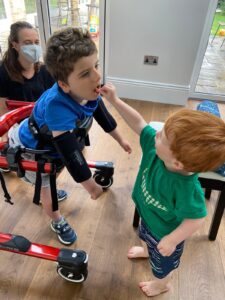
However, he was still not fully weightbearing in his Pacer. Henry had the ability to stand independently at a surface for around 2 minutes, and to stand with light hip support only, for around 1 minute. He could also stand in his Meerkat standing frame, with support at his hips and below only, for 15 minutes. These skills showed that Henry was perfectly capable of bearing more weight in the Rifton Pacer, and potentially learning how to weight shift and step with much less support. However, due to Henry’s weakness and low tone, this would be for short periods of time, with a therapist for safety, and for therapeutic use only to start with.
Therefore, Henry’s chest prompt was removed, and waist height handles were added. Henry was physically assisted with a therapist on a wheely stool, to weight shift at his hips and step. Henry was able to do this around 8 steps, 3 repetitions per session and it was a great trunk strengthening activity, to help prevent scoliosis and activate some trunk rotation when stepping. The Opposite set up was also used during treatment sessions: the saddle was removed, and the chest prompt was moved down to Henry’s hip height. This was a great way to get some active, dynamic weight bearing into his therapy sessions, but it was much harder for Henry, and he managed around 2 steps. He could statically stand very well like this though, and as he had a very high risk for hip subluxation, this was still a useful method to encourage more weightbearing.
This brought the idea for using the Rifton Pacer as a dynamic stander. Henry already had a Meerkat stander, which is excellent for trunk strengthening when used with hip support and below only. However, due to the solid knee blocks and feet support, as well as the hip support, it provides the same lower limb support as any other passive standing frame. This can range from between 0 and 100% of total body weight, but has been shown in research to be below 25%.
So the Pacer was set up with no foot or knee support, and with hip support only (the chest prompt moved down). As Henry could stand with light hip support, we knew this was possible. But supporting Henry to get into standing with hip support only from a therapist, was becoming increasingly difficult with moving and handling, due to Henry’s weight and size. It was also not possible for the therapist to interact with Henry or position his body at all, because their hands were occupied holding him.
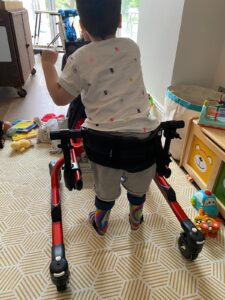
Henry was placed on a therapy bench, with a large surface in front. He was assisted to stand up in the Rifton, with trunk support only and with the bulk of the walker in front of him. It needed to be on the lowest height possible, as Henry would lean on it otherwise. Then the chest prompt was brought up to the desired height individually. When the chest prompt was fastened around Henry’s hips, while he leaned on the surface, he was brought up with arm support into upright standing, and another adult removed the surface.
Henry immediately stood for about 5 minutes, longer than he ever has with a therapist! Probably because the Rifton was much stronger than the therapist’s hands! Over time, Henry built up his standing to 15 minutes. He started watching a screen only, and could not participate on anything else. He was able to reach high and low, left and right for objects and place them in a box, after around 6 months. We then added a wobble air filled cushion under his feet, for some even more active standing! Henry loved the challenge, and did this for about 2 minutes!
Henry had some tightness in his calf muscles. So his AFOs were removed, and he wore shoes with arch support only in the same standing set up. This allowed dorsiflexion of his ankles for an active, sustained calf stretch, and was carried out on the wobble cushion, and with a wedge aiding dorsiflexion.
Overall, Henry worked extremely hard and for someone with such low muscle tone, he had a very strong core and no scoliosis. This really aided in his quality of life, he was happy, smiley, motivated and strong, and his trunk strength allowed him to sit, stand, kneel and lie on his tummy while using his arms to play with all his favourite toys. He will forever be remembered, and this treatment approach will be used over and over in the future, to aid many other superheroes with conditions similar to Henry’s. Thank you Henry for inspiring us all and helping us to help others.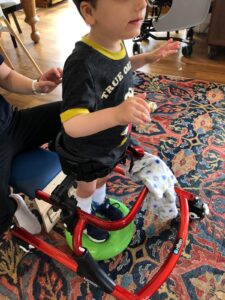
Bumble Bee Physiotherapy a specialist children’s physiotherapy service, and provide fun and quality paediatric physiotherapy in the comfort of your child’s home, school or nursery. We operate in London and surrounding areas. For more information, visit our website – Children’s Physiotherapy London – Bumble Bee – Bumble Bee Physiotherapy
This guest blog is part of our 40 stories for 40 years’ series, celebrating our partnerships over the years. Click here to read more blogs in this series.