In our final 40 stories blog post, we hear about Ellie, a young girl who is hard at work developing not just her physical abilities, but her social and communication skills!
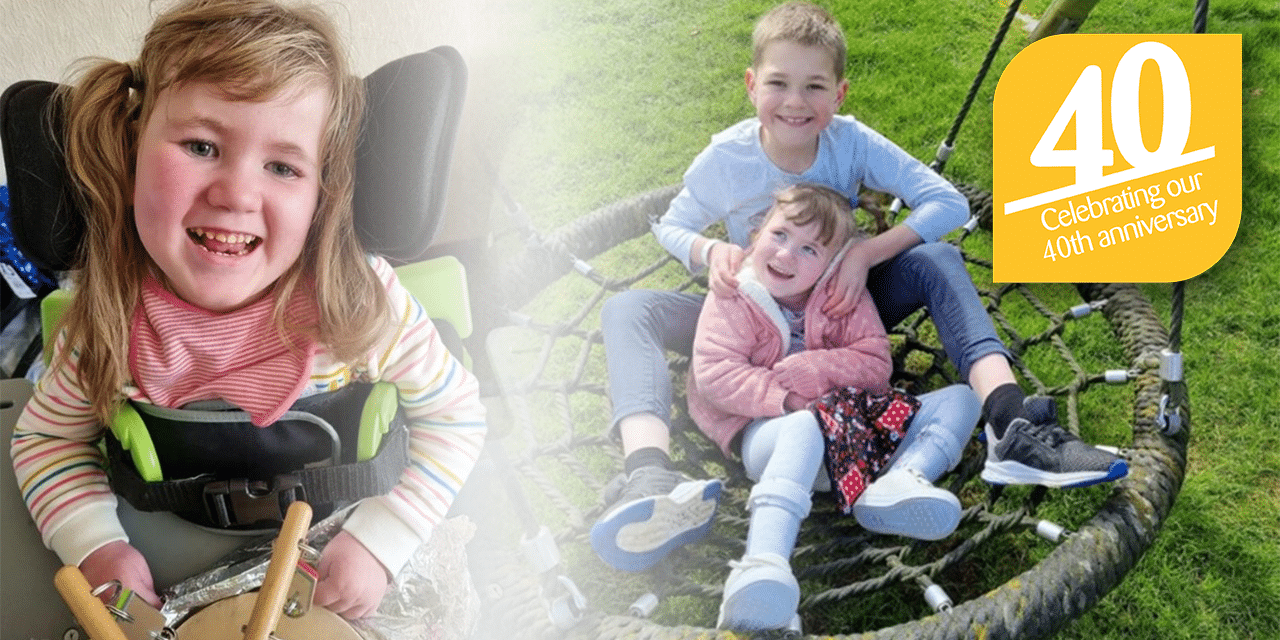
 Meet Ellie. Ellie is 6 years old and lives in Moray, Scotland with her mum, dad and big brother Cameron. Ellie is a big fan of Disney musicals and likes to play with her Linkimal animals and her sensory toys. She likes going on walks and going to the park with her family and friends. She loves to play on the accessible swing and roundabout in the park! She enjoys going to school daily to see her friends.
Ellie has a diagnosis of Cerebral Palsy and Hydrocephalus and is affected by weakness throughout her body. Her limitations in gross motor function are equivalent to GMFCS level V.
She struggles with her head control and is working hard to develop this with her therapy programme. She is non-verbal but is learning to communicate her needs through different methods. Ellie has a severe sight impairment and has difficulty eating and swallowing. She has a gastrostomy in place to help with her feeding and maintaining weight, but she does also eat a small amount of pureed foods.
Ellie’s needs require 24-hour care and postural support from her doting family, supported by school and medical teams.
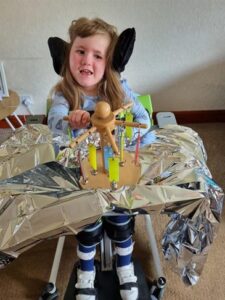
One support to help with her standing activities is the Jenx Multistander!
Mum Vicki says:
“Ellie loves the Multistander and uses it daily. She loves to play with her foil blanket and make lots of noise whilst standing. She finds the stander so comfortable, and when she’s not playing in it, she often falls asleep in it! ”
Supported standing provides multiple potential physical benefits to Ellie:
- Prolonged stretching to her hamstrings to help maintain range of movement in her lower limbs.
- Weightbearing through her lower limbs that may aid bone density and hip stability.
- A reduction in compression internally, that may occur more commonly in sitting, that may aid bladder, bowel and respiratory functioning.
But the Multistander is much more than just a physical aid, and Ellie enjoys standing to play, communicate, learn and interact with the world around her.
Ellie works hard in the Multistander to use her switch devices for communication and to play with her sensory toys with Granny.
Features of the Multistander that help support Ellie’s posture and daily activities: 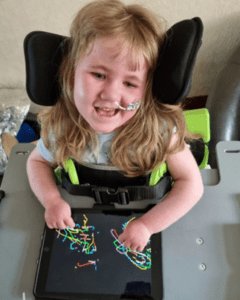
The tray is perfect for supporting Ellie’s favourite toys to encourage midline play and development of upper limb control. It can also safely support her enteral feeding pump so she can continue to stand and play whilst a feed is running.
The Multistander provides highly adjustable and modular postural accessories that can support the individual and unique needs of Ellie. Support from head level allows her to have independent play time with her toys and devices. It also reduces the care burden and allows for free time for her family, who are safe in the knowledge that she is standing securely, comfortably and happily.
Here’s Ellie drawing a fabulous picture on her iPad!
Standing allows for more play and interaction with Cameron and friends. Ellie has a close bond with her big brother and the supports of the Multistander mean Cameron can focus on helping her safely use her upper limbs in activities. The trunk laterals, headrest and tray all work in combination to ensure he can gently guide her elbows and forearms as they interact together and continue to develop their close sibling bond.
Ellie, Multistander and the F- Words (1,2):
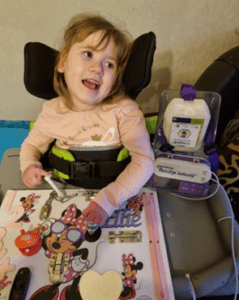 Fitness – Supported standing has many physical benefits for Ellie. It is most importantly a change of position to aid muscular extensibility and may help prevent postural deformity. Weight bearing in the stander may be beneficial for bone density and hip stability. Standing may aid respiration, digestion and bladder and bowel functioning. Standing might also be a form of light physical activity for children at higher GMFCS levels. The Multigrip head support keeps Ellie’s head posture in midline meaning she’s not having to work as hard on her postural control. This may aid her vision and exploration of the environment close to her as objects can be brought into her field of view more easily.
Functioning – The extensive support from head level down helps reduce Ellie’s exertion when playing or performing a task and allows for more focused control and movement – particularly through her upper limbs. She continues to work hard on her communication by reaching and pushing her switch devices on the Multistander tray.
Friends – Supported standing can enable eye level play with more ambulant friends, but also aids interaction and familiarisation with other friends who also use standing frames for learning and play.
Family – Whilst the Multistander clearly encourages lots of play and family interaction in a loving home environment, it also helps ease the care burden. Ellie can play safely and independently with her sensory toys allowing some free time for her family carers.
Fun – The Multistander is not just being used purely ‘to stand’. It is a therapeutic device for lots of play, exploration and learning. It moves from room to room, and even outdoors at home, so Ellie’s standing is never static or boring!
Future – The Multistander will continue to grow with Ellie over the next few years thanks to its highly adjustable features. Supports can easily be added or removed as her needs change or skills develop so both Ellie and family can continue to feel safe and happy whilst standing.
Click here to download Ellie’s Case Study
References:
1) World Health Organization. (2001) International Classification of Functioning, Disability and Health (ICF).
2) Rosenbaum, P. & Gorter J. The ‘F-words’ in childhood disability: I swear this is how we should think! Child: care, health and development. 2011; 38(4): 457–46
This blog is part of our 40 stories for 40 years’ series, celebrating our partnerships over the years. Click here to read more blogs in this series.