Written by Kieran Murphy, Clinical Partnerships Manager 
A fascinating new article has been recently published in The Lancet, summarising the global progress in cerebral palsy (CP) research over the years, and highlighting the exciting research in place for years to come [1].
Written by Iona Novak (who has previously delivered must-see webinars in collaboration with Jenx: https://www.youtube.com/watch?v=FbscJlPknBU&list=PLoye-0vkFJjX4xWlXaMbHy2osE37etUbE) and her colleagues Michelle Jackman, Megan Finch-Edmonson and Michael Fahey, the review answers common questions asked by people with CP, using the best available evidence.
It is also supplemented with a brilliant plain language summary that is designed with families and community members in mind:
https://cerebralpalsy.org.au/wp-content/uploads/2025/06/Novak2025_Cerebral-Palsy_Supplementary.pdf
Some Key Takeaways relating to postural care approaches:
- Advances in early diagnosis mean CP can be diagnosed as early as 3 months of age
- Starting therapy early —especially before 6 months—can improve motor and hand skills and may also help with feeding and communication.
- Early support for thinking and learning, through play, technology, and education, is just as important as physical therapy for children with cerebral palsy.
- Starting postural management approaches early and throughout life helps prevent deformities for children with more severe motor needs.
- Standing frames are encouraged to support mobility and social interaction.
- Sleep positioning systems: Often used to help with comfort and body alignment, but they haven’t been shown to improve sleep. They are not recommended for infants due to safety concerns.
With the appropriate pathways and assessments in place, CP can be diagnosed early, meaning support can be provided promptly. Infants exhibit remarkable neuroplasticity, which is the brain’s ability to reorganize itself by forming new neural connections to the input it receives. The first few years of life are generally considered the peak of critical periods for neuroplasticity, where the brain’s ability to change in response to experiences requires much less effort:
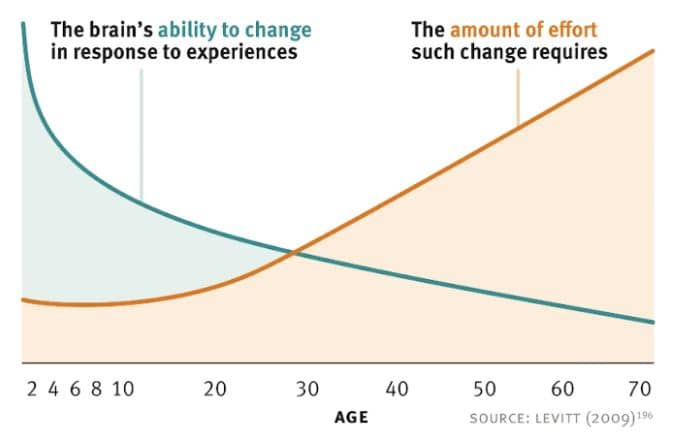 https://developingchild.harvard.edu/key-concept/brain-architecture/
For the children with more severe motor impairment, it is vital that they are provided support to move and interact with the world during these critical windows in a similar manner to their peers and maximise their potential. Adaptive equipment is essential. Some seating systems can support sitting development from 6 months of age, some standing frames might encourage weight-bearing from 9 months of age, some gait trainers might support stepping practice before 12 months of age. They can all facilitate play, movement and learning:
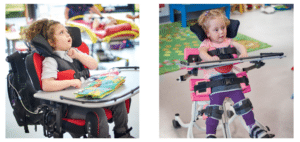
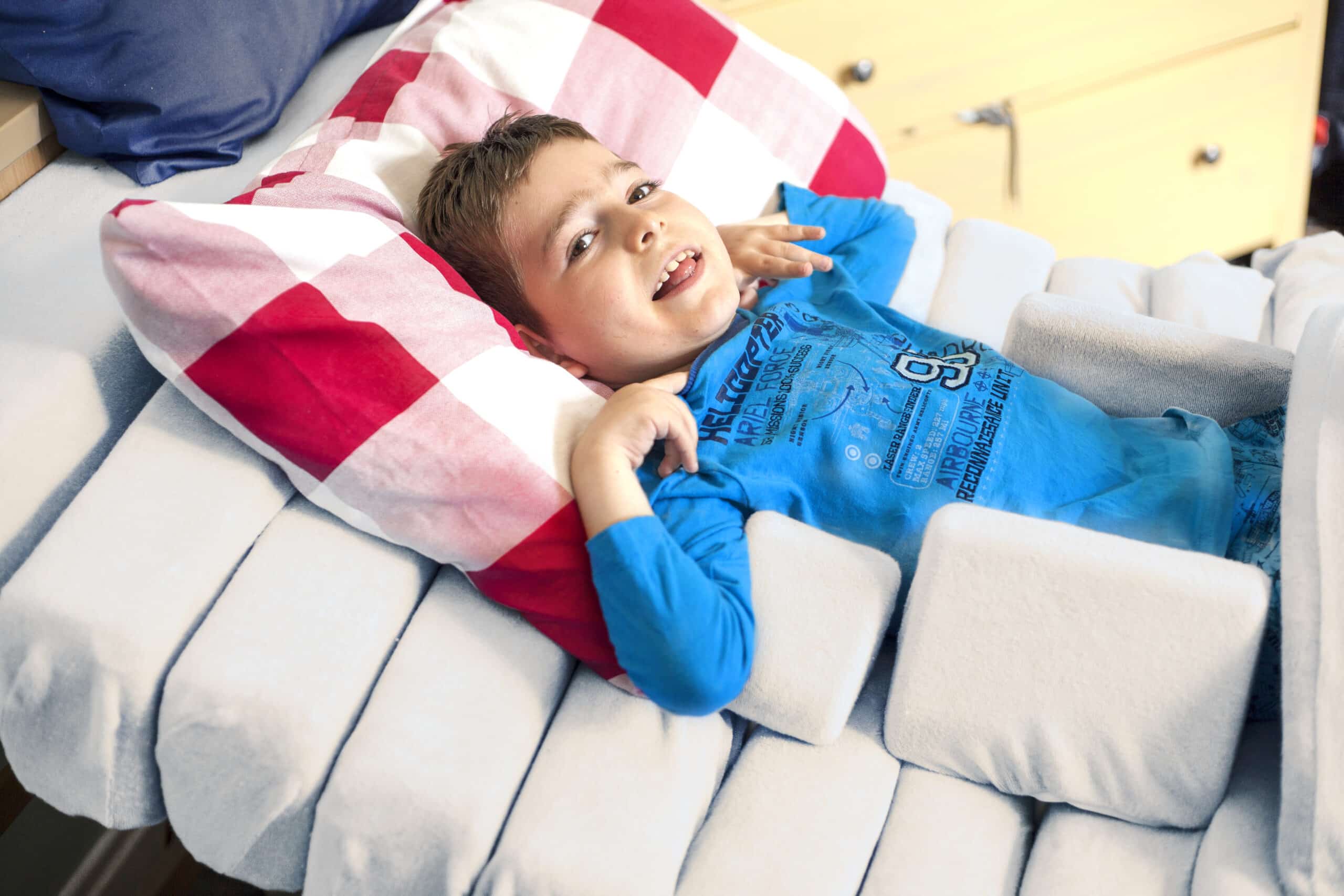
Application of postural care from early in life helps to delay or prevent the adoption of more fixed, ‘destructive’ postures that may be associated with postural deformity and functional decline as the child grows. For example, a windsweeping posture (where the legs deviate to one side and can be associated with pelvic tilting, rotation, spinal scoliosis and hip displacement), can be reduced with leg and hip guides on a chair, de-rotation straps at the knees and pelvis in a standing frame, or abduction blocks and positioning pads in a sleep system:
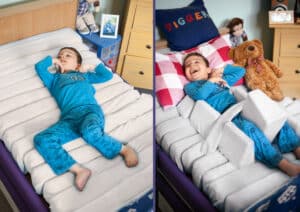
The resource does indicate the sleep systems (SS) haven’t been shown to improve sleep and are not recommended in infants. There are some key considerations to reflect upon here:
- Research into night-time positioning is still building, and is affected by the uniformity required in ‘Gold Standard’ studies. Children with CP are diverse in their needs and presentation, and the sleep systems they may access are equally diverse in their setup and application.
- SS can improve sleep, but research is often focused on exploring how adaptive equipment can minimise impairment and improve bodily functioning. We need to proactively consider the occupation of sleep during the prescription process, including the caregiver’s sleep. Useful resources include sleep diaries, and here at Jenx we have created handy toolkits to support this process – click here to access
- The use of SS overnight is not recommended for infants, in a similar manner to the advice given for minimising risk of Sudden Infant Death Syndrome, and due to concerns they could elevate the risk of gastroesophageal reflux, breathing difficulties, and death. However, international guidelines have also stated that “care should be taken to ensure the hips are not positioned in extension and adduction because of the risk of hip dysplasia” [2]. Furthermore, it is important to remember that SS do not have to be used exclusively overnight, they can be introduced early as part of daytime positioning where careful monitoring can more easily take place.
It is important to establish appropriate lying postures early, as children can quickly associate a destructive posture with their ability to fall asleep [3]
An exciting future
The resource also highlights the exciting progress made in ground-breaking interventions such as stem cell therapy.
“Umbilical cord blood is safe and has been shown to improve movement in young children with cerebral palsy who can walk or are likely to learn to walk (GMFCS levels I–III). It works best when given early (under age 5) and in higher doses”.
An overview of current clinical trials is provided, with some trials having the potential to change thinking and practice in the near future!:

References
[1] Novak, I., Jackman, M., Finch-Edmonson, M & Fahey, M. (2025) Cerebral Palsy. The Lancet, 0,0. https://doi.org/10.1016/S0140-6736(25)00686-5
[2] Morgan et al. Early Intervention for Children Aged 0 to 2 Years With or at High Risk of Cerebral Palsy: International Clinical Practice Guideline Based on Systematic Reviews. JAMA Paediatrics. 2021; 175(8), 846-858. 10.1001/jamapediatrics.2021.0878
[3] Baylis, M. 24-Hour postural care and use of sleep systems in cerebral palsy. Paediatrics and Child Health. 2020; 30(8), 296-302.
About the author – Kieran Murphy
Kieran qualified as a Physiotherpist in 2016 at the University of Salford and later attained an MSc at the same university in Advanced Physiotherapy. He completed his core rotations before becoming a senior paediatric physiotherapist for the NHS in Great Manchester, UK.
Kieran’ s experience as a physiotherapist has seen him provide a wide range of holistic therapy to children with developmental delay, complex neurological and physical disabilities and musculoskeletal injuries. He continues to work alongside his role as Clinical Partnerships Manager for Jenx with a small caseload of private patients and as a locum therapist.
Kieran has a keen interest in supporting adolescents with cerebral palsy and the management of hip dysplasia.
In his spare time Kieran is passionate about football and enjoys fishing.