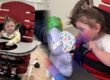
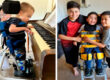
In this week’s 40 stories blog post, we’re hearing about Ava, who uses both the Jenx Junior + Chair and Standz standing frame for postural support!
 Meet Ava. She is 6 years old and lives in Essex, UK, with her mum Claire, dad John and little sister Fia.
Ava loves swimming, sensory play with lights and bubbles and grooving to her favourite music – Hip Hop and R & B! She likes going to school daily and spending time with her friends there.
Ava is a SWAN (syndromes without a name) undiagnosed child.
Her needs require 24-hour postural care – provided at home by her devoted family and supported by school and therapy teams. She is affected by hypotonia, global developmental delay, visual impairment, and frequent respiratory illnesses. Ava cannot speak but is currently learning to communicate through non-verbal methods. She works hard to build her strength and develop her physical skills with her daily physiotherapy programme. There are two helping hands that are also key to Ava’s daily routine – the Jenx Junior + Chair and Standz standing frame! Claire details some of the significant therapeutic benefits both products provide to Ava in some recent Instagram posts.
“Ava’s standing frame helps her to stand. Ava uses her standing frame for one hour each day. It supports her trunk, waist/hips, knees and ankles to keep her in a supportive position and stand up right. This piece of equipment has so many health/physical benefits for Ava but it also helps her interact with friends/family at eye level. Ava enjoys being in her standing frame. Her head gets tired after a little while due to her low tone/weaker neck muscles but she is working on this!
Ava has two chairs, one at school and one at home. This is one of Ava’s most used pieces of equipment – she uses it several times a day for eating/drinks, medical treatments, playing/activities and just day to day things.”
To see more of Ava’s story and how all of her therapeutic equipment supports her daily activities, click here.
Features of the Standz and Junior + that help support Ava’s posture and daily activities:
The high low base on the Junior + chair helps Ava play with her sister at their play table or eat with her family at the dinner table. Fia loves to sit on her big sister’s lap and cuddle her and the postural support provided by the Junior + means these loving sibling interactions can be done safely.
Ava uses a second Junior + at school as she is so comfortable and well supported in the chair. The familiarity of the chair allows for consistency with play, learning and interaction at both home and school.
Claire reports the back recline and tilt in space on the Junior + is helpful for encouraging relaxation, rest and change of sitting posture for Ava. This is also important for ease of care and reducing anxiety as Ava requires regular suctioning of her airways whilst using her equipment.
 The modular supports of both the Junior + and the Standz mean Ava can be supported throughout her whole body. She is currently working hard on her head control and skill with her eye gaze device. The comprehensive supports can allow for focussed head control and energy conservation, but the easily adjustable headrests also allow for challenging of control and encouraging skill development.
The sturdy trays on both the Standz and Junior + are perfect for practising using switches so Ava can communicate with her family and friends. They are also perfect for supporting toys and for sensory play!
The Standz can be gradually brought into upright standing – which is useful for aiding Ava’s respiration, weightbearing and head control. It also rises to the perfect height for play and cookery at the kitchen counter with Mum and Fia!
Here is Ava making some delicious cookies with her mum and sister whilst standing in her Standz!
The castors on both the Standz and Junior + are also robust enough to manoeuvre from room to room or even outdoors at home! Ava loves outdoor play and experiencing the different sensations this brings. She also rocks sunflower sunglasses better than anyone – check them out in the header photo for this blog!
Ava, Standz, Junior + and the F- Words (1,2):
Fitness – The opportunity for changes of sitting and standing positions, combined with the tilt in space features help aid Ava’s respiratory effort and mobilisation of secretions for clearing of airways. The modular postural supports encourage stable and symmetrical sitting and standing which may prevent postural deformity in the future and maintain internal organ health and functioning.
Functioning – The comprehensive support of both the Standz and Junior+ encourage repeated practice and development of head and upper limb control skills. This is important for play and interaction, and in particular communication. Ava continues to work hard with her switch and eye gaze devices, which allows her to interact more with the world around her.
Friends – The high low base of the Junior + can encourage floor play or play at table height in school with Ava’s friends, whilst the Standz encourages eye level interaction in standing with all her friends, regardless of physical ability.
Family – The Standz and Junior + fit perfectly into the home environment and are mobile enough to move from room to room and even outdoors. Ava’s family help her to use both postural support devices functionally. They are not just for sitting and standing – they are for baking, sensory play and reading!
Fun – Ava loves to play in her standing frame and seating system. The trays are perfect for holding toys, encouraging messy play or for experiencing new textures.
Future – Thanks to their adjustability, both the Junior + and Standz will grow with Ava in years to come. They will provide familiar postural support for maintenance her skills, but can easily be adapted to meet her needs should her motor skills continue to develop.
Click here to download Ava’s Case Study
References:
1) World Health Organization. (2001) International Classification of Functioning, Disability and Health (ICF).
2) Rosenbaum, P. & Gorter J. The ‘F-words’ in childhood disability: I swear this is how we should think! Child: care, health and development. 2011; 38(4): 457–46
This blog is part of our 40 stories for 40 years’ series, celebrating our partnerships over the years. Click here to read more blogs in this series.