Guest blog by Catherine Barton, Paediatric PT, Potter’s House CBO
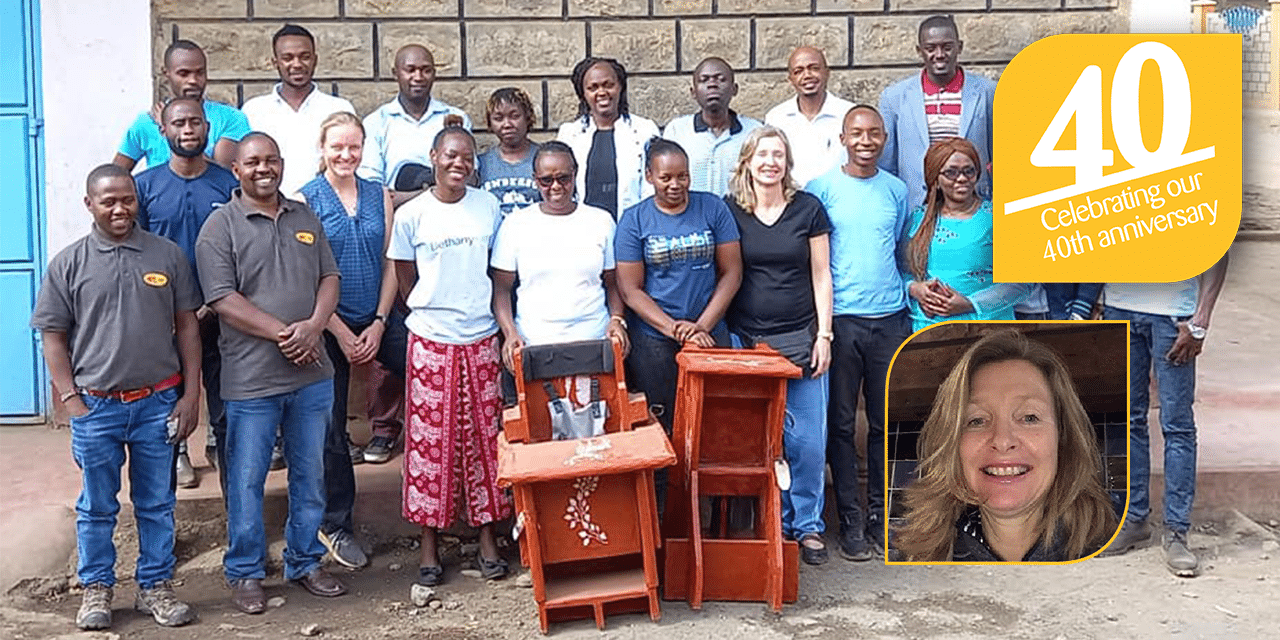
As a paediatric physiotherapist doing some voluntary work for a charity in Kenya, the Potter’s House CBO, I have been involved in training local therapists about postural management and training local staff to make seats and standing frame from recycled paper and cardboard. I would like to share the beauty and success of this project.
An estimated 114,500 children are born with cerebral palsy in Kenya each year, and 70% of these children live in poverty. Nearly half of these will be unable to sit or stand unsupported. Cerebral Palsy is the most common form of physical disability in children worldwide but there are many others that also mean the child cannot sit or stand unaided. The lack of medical expertise, lack of well-fitting, suitable equipment and the high cost of any equipment that might be available makes it virtually impossible for parents to get their child the equipment they need and place them in a good postural position. Without good postural management, children often develop painful and fixed contractures such as hip dislocations, limb contractures and spinal deformities. They are trapped in their homes and cannot participate in family or community activities. Ignored by those around them, stepped over or forgotten, they have an isolated and often painful existence.
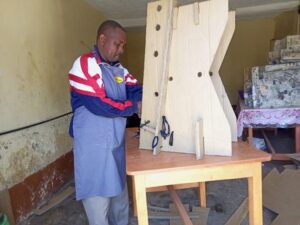 The APT Kenya project started in February 2022 in Njoro, Nakuru county in response to the needs of these children. APT or Appropriate Paper-based Technology is a sustainable solution using readily available, cheap and recyclable waste cardboard, newspaper, and flour-based paste to make chairs and standing frames for postural support. In the workshop run by the Potters House CBO, layers of cardboard are glued together using a flour and water paste and covered with multiple layers of paper before being painted and decorated.
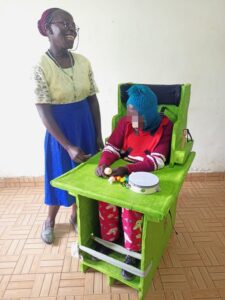
To date, 145 devices have been made. Extensive feedback from parents shows that the devices have improved posture, communication and participation in family life. Incidences of stigma and prejudices have reduced, and the devices have made caring for their child easier. The APT KENYA project goes hand in hand with the charity’s work with families; parents are employed to do the less skilled work of papering and painting, which has enabled them to pay school fees and feed their family. We are also using APT as an activity to engage street connected children on Saturdays, giving them a safe space away from the streets where they learn transferable skills, get creative and can take home the household items they make such as stools and wastepaper bins. In total 721 children and adults were provided with services, support or activities throughout the last year.
Other successes include practical training delivered to two other organisations in 2022 and 2023 with new APT workshops being established that continue to produce devices. 17 Kenyan therapists received training and this knowledge of postural management for complex disabilities and the use of APT will be further disseminated. The project has brought a community together, is helping to break down the barriers and stigma people living with disabilities in Kenya face and is changing lives.
So far, the project has been funded by The Wales-Africa Grant Scheme and the Multi agency training support scheme making it possible for APT KENYA to continue and to grow. We are now seeking funding to keep APT KENYA going in 2024.
To find out more about the project and ways you can help APT KENYA continue to transform children’s lives, go to our website and follow us on Facebook.
This blog is part of our 40 stories for 40 years’ series, celebrating our partnerships over the years. Click here to read more blogs in this series.
About the Author:
Catherine trained at the London school of Physiotherapy and East London University and has worked in the National Health Service (NHS) for over 30 years. She has spent most of her career working with children, having specialised in outpatient neurology at the Birmingham Children’s Hospital. She is Bobath trained and passionate about early intervention and postural management for complex neurological and orthopedic conditions. In recent years she has worked part-time in the rural community of Powys where she joined a community health exchange visit to Kenya in 2014. Having seen first-hand the overwhelming need for community support for children with disabilities in Kenya, she became interested in Appropriate Paper-based Technology, or APT. Catherine gained a master’s degree in research at the University of Chester in 2020, which involved a research project which evidenced the benefits of APT devices for children with cerebral palsy in Kenya, which was published in a peer reviewed journal:
Barton C, Buckley J, Samia P, Williams F, Taylor SR, Lindoewood R. The efficacy of appropriate paper-based technology for Kenyan children with cerebral palsy. Disabil Rehabil Assist Technol. 2022;17(8):927-37. DOI: 10.1080/17483107.2020.1830442