Guest blog from Luis Santos, Physical Therapist at Rahapoint, Jenx’s distribution partner in Portugal. 
First of all, I believe it is important for all of us – therapists, dealers, clients, and their families – to express our sincere gratitude to Jenx for their remarkable work over the past 40 years. They have consistently provided us with ingenious products and exceptional care.
Now comes the hardest part: the task of choosing one piece of equipment to talk about or a clinical review of the application of a Jenx product that had a big impact when all of them are so special and significant in all the cases.
That being said, I could talk about all the success that we made along our journey of seating with Jenx every time that we apply a Junior+ or Multiseat and how many years they grow with our clients. I could also talk and try to make the unfindable accounting of how many Monkey, Penguin and Kangaroo standers we delivered all along these years, and try to find a paediatric rehab centre in Portugal that we couldn’t find one of those in, and it would be even a harder task.
So, for this review, I decided to write about the product that I felt that was the biggest game-changer and that was most consensual between therapists about how it was so different from the rest of the night-time solutions and how necessary it was for so many clients; of course I’m talking about Dreama! We know that 24h Positioning was already a big theme in many countries, but in Portugal we were still working too much with seating, standing and mobility and most of the time sleeping was resumed to an electric bed, a good mattress and some special pillows or accessories to help to position. The Dreama brought us a complete and innovative solution that was a problem solver for many users and families. I cannot forget the impact of my first Dreama delivery, which not only revolutionized their night-time experience, but also positively affected their seating position over time.
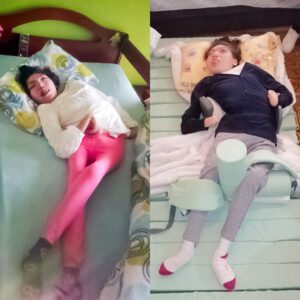
The pictures that accompanies this article were taken during the evaluation of that particular case. In the “before” photo, you can observe how the individual woke up each morning with scoliosis and a crossed leg pattern, making it increasingly challenging to maintain a seated position due to a progressively diminishing range of movement. After using Dreama for a while, she was able to spend more time in her wheelchair. It became easier for her family to position her, and the need for frequent repositioning throughout the day diminished. This relationship between sleeping/laying position and sitting position is often overlooked. It showcases the immense potential of Dreama, not only in terms of its evident benefits during sleep for the user and caregivers, but also in facilitating more achievable seating positions for clients with complex positioning needs.
Sleeping and rest are vital for everyone, particularly for individuals with special care needs. Additionally, we must recognize that the sleeping patterns of caregivers are frequently disrupted due to the night-time needs of their loved ones. As mentioned before, Dreama truly lives up to its reputation as a game-changer.
As therapists, we are not merely problem solvers; we are catalysts for transformation. We have the privilege of witnessing the smallest victories that lead to monumental breakthroughs. It is in these moments, when a client can sit with greater ease or a caregiver can find solace in a peaceful night’s sleep, that we realize the profound impact of our efforts.
So, let us express our heartfelt gratitude to Jenx for their unwavering commitment to improving the lives of individuals with special care needs. And as we forge ahead, let us remember the transformative power of Dreama, and the countless opportunities that lie ahead. Together, we can create a future where comfort, inclusion, and boundless potential are the norm.
For more information, and to access the range of Jenx Sleep Resources, read our recent blog – The Occupation of Sleeping
This blog is part of our 40 stories for 40 years’ series, celebrating our partnerships over the years. Click here to read more blogs in this series.