Guest blog by Ella Makin and Fiona Beckerlegge.
After spending six long years building his dream lodge in Uganda, Steve Williams faced his biggest struggle yet when he and his wife, Asha Williams, gave birth to their son, Sidney, who was born with severe epilepsy and developmental delay. After struggling to find any appropriate care in Uganda – and realising that many other families were facing similar and even greater challenges – they felt compelled to act. In 2014, alongside Fiona Beckerlegge, a paediatric physiotherapist, Kyaninga Child Development Centre (KCDC) was born.
Children with disabilities are one of the most marginalised groups worldwide. In Uganda, 13% of all children – more than 2.5 million – are living with a disability. Widespread local beliefs that disabilities are an ‘untreatable curse’ mean that these children and their families are frequently ostracised from their communities, educational and healthcare institutions, and social and leisure activities. Unsurprisingly, this affects their overall health outcomes and development, as well as impeding the economic independence of their families.
At KCDC, we primarily provide specialised and affordable healthcare, education and assistive technology to children with disabilities across Western Uganda. We also provide support to their caregivers, family members and local communities. KCDC is currently the only regional organisation taking a holistic, community-based approach to disability and has helped over 6,000 children with disabilities and their families over the past eight years. However, this figure is estimated to be less than 1% of all children with disabilities in the region.
The Therapy and Rehabilitation Centre was the starting point for KCDC. It now provides more than 900 therapy sessions each month, including physical, occupational and speech therapy, as well as orthopaedic splinting and casting through 2 daily outpatient clinics and our community-based rehabilitation programme.
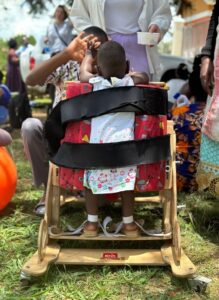
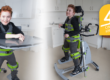
This programme partners with local health centres – as well as making visits to individual families who are unable to reach us at these centres – in order to increase access for rural communities. Our multi-disciplinary rehabilitation team often set up their community clinics under the trees, as space inside the health centres is extremely limited. We always take all our equipment with us as we also only have a limited number of standing frames, walkers and seats to support our therapy programmes. We received a donation of used therapy equipment – including Jenx standers and corner seats – through PhysioNet in 2015, which we still use daily and can often be seen riding on the roof rack of the car as we travel around the region.
KCDC also works to increase access to education for the 91% of children with disabilities in Uganda who are not enrolled in primary school. This is carried out through our Kyaninga Inclusive Education Hub, which equips local teachers with the knowledge and tools to deliver inclusive education and participatory learning for all. Meanwhile, Kyaninga Inclusive Model School helps to realise this vision by bringing together children with disabilities and typical learners from diverse socio-economic backgrounds to learn side-by-side. 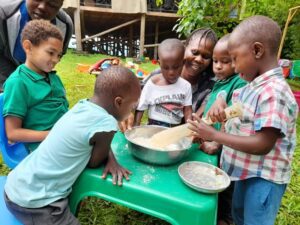
Beyond our main programmes, we also offer community nutrition clinics for preventing and managing malnutrition, as well as community epilepsy clinics, a Street Business School for female caregivers of children with disabilities and a variety of community awareness and advocacy workshops.
In Uganda, only 0.5% of people who need a wheelchair have one, as they are extremely expensive to import and the demand for donated ones far outweighs the numbers available. They are also not suitable for the local terrain, break easily and are not fitted for the individual user. Kyaninga Mobility was established in 2020 to design and develop high-quality, low-cost, terrain-suitable wheelchairs and other mobility aid designs made from bamboo and other locally available resources. All aids will be provided free of cost to children at KCDC, with third-party purchases enabling the company to become financially self-sustainable. The remaining proceeds will be reinvested back into KCDC. We currently have a 300-person priority waitlist for these devices. 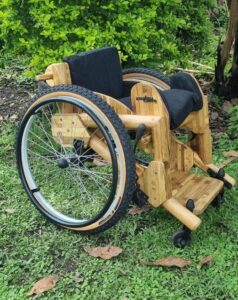
We are so grateful for all the donations that have enabled us to pursue this project and cannot wait until production finally begins later this year!
If you are interested in helping us to continue pursuing our goal of every child with a disability in Western Uganda having the necessary therapy and mobility aids to lead a meaningful, quality life, please visit the following page: https://www.kyaningacdc.org/make-a-donation/.
This guest blog is part of our 40 stories for 40 years’ series, celebrating our partnerships over the years. Click here to read more blogs in this series.