How One Boy is Gaining Ground with Trexo
Guest blog by Lori Potts, PT, Rifton Product and Training Specialist
Trexo was born in an engineering lab at the University of Waterloo in Ontario, Canada. It was there that Manmeet Maggu, in his final year of engineering studies, decided to design a robotic assist to attach to a gait trainer in the hope of helping his nephew learn to walk. It was his final project.
The project was a success. Manmeet watched his nephew Paneit, who has cerebral palsy, take the first steps of his life. And, less than 10 years later, Manmeet was CEO of Trexo Robotics.
Trexo is a robotic exoskeleton that attaches to a Rifton Pacer gait trainer. Together, the Pacer and Trexo support a child in an upright position while allowing for lower extremity movement that is controlled, physiological and repeatable. By adding robotic assistance it’s possible to increase the amount of time a person gets gait practice. And generally, the more gait practice you get, the better. This, it turns out, provides countless therapeutic and long-term benefits.
The Trexo Home consists of two robotic legs that attach onto the child’s legs and can provide variable powered assistance to help the child with initiation of steps and with continued stepping in a healthy physiological gait pattern. With the support of robot-assisted walking, a child has the opportunity to be out of the wheelchair, practicing walking skills.
The Trexo Home is adjustable in size, width, and height. It is designed to grow with the child. And, as the child gets stronger, the Trexo Home can be adjusted to provide less support with weight-bearing and stepping, thereby increasing the child’s independence.
The Trexo ensures a proper alignment, normal walking speed and cadence, and the consistent stepping necessary for improved endurance and patterning for gait. Performing a normal and consistent walking speed with appropriate repetition may even improve joint range of motion within these positions of gait. The Trexo has a data system that keeps a record on the number of steps, the amount of initiation for each step, and the cadence of stepping (that is, the number of steps in a given time) and by doing this, can show the child’s progress.
The Trexo and Pacer in combination
In comparison to traditional gait trainers, the Trexo and Pacer in combination provide the opportunity for independent mobility, enabling the child to be in an upright position while achieving a mature and appropriate gait pattern. The caregivers do not need to support the child’s body weight or assist with step-taking, so the caregiver does not tire and the child can potentially spend more time walking.
For children who are otherwise dependent, regular supported walking can also improve the child’s trunk control and strength. Being upright and mobile improves respiration, digestion, circulation, bowel/bladder function, and provides the opportunity for robot-assisted muscle activation, muscle extensibility, and bone development.
The Pacer can be used both indoors and outdoors. When children are at eye level with their peers, their social, emotional and physiological development is enhanced – all necessary for the growth of a well-rounded and healthy child. Inclusion with peers is a profound motivator for movement. The Pacer frame ensures safety, comfort and provides support, even for a non-ambulatory child, like my own nephew, 8-year-old Robert, who also has cerebral palsy.
Robert and the Trexo
Robert was 8 years old when he walked in the Trexo for the first time, on August 11, 2022. View the video below to see Robert with family and friends on that special day.
Over the next months, Robert used the TREXO and Pacer combination regularly. The improvements in his well-being astounded family and friends alike. His parents have agreed to share these remarkable health gains with you.
Alertness, energy, and joy levels
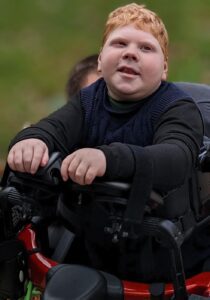
Rob’s interest in life has increased. Not only does he keep his eyes open during the Trexo walks, but he is now awake and alert for most of the day, no longer spending time “hibernating” with his eyes closed. He is obviously taking in much more, and responding to interactions with others, particularly his peers. His overall energy level is improved – he is now a far more robust child, with more joy in life – previously, a smile from Rob was a rare occurrence. Now it is a normal part of life!
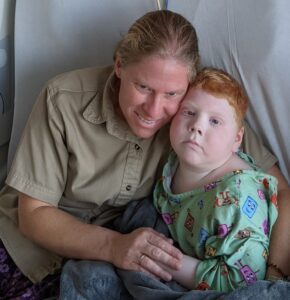
Robert in hospital, with his mother, in November 2021.
Robert in his Trexo in November 2022.
Pain and discomfort
His parents notice that Rob’s pain and discomfort is markedly less – they would estimate an 80-90% reduction in pain. Since spending more time active in the Trexo, Rob can now better tolerate being in sustained positions such as passive sitting. He used to complain and be very uncomfortable after a short period of sitting, but now he can be present at prolonged social events, remaining comfortable and relaxed.
Core strength
Rob’s core strength has demonstrated significant improvement the more time he spends in the Trexo. In fact, Rob was provided with his first TLSO (customized back brace) two years prior, in August 2020, due to early evidence of scoliosis. X-rays in August 2022 showed that Rob’s spine alignment had improved with use of the brace. Now, Rob no longer wears the brace. Because his spine is now healthy, and because his trunk control is so markedly improved with the Trexo, Robert’s orthotist agreed that he can discontinue use of the TLSO. His parents notice that even without the brace Rob can now last longer in his adaptive chair, sustaining the sitting position for a longer time. He is more peaceful, too.
Head control
As Rob continues to use the Trexo, his head control has improved. Rob gets regular Chest PT treatments; previously, he always relied on his neck support during this treatment; now he does not always need it. As time progresses, Rob uses his neck support less and less while in the Trexo. Even when out of the Trexo, such as when in his adaptive chair or in his stander, he can sustain his positioning without the neck support more often, and for longer stretches of time. This one improvement alone has a big impact on his social interactions with family and peers.
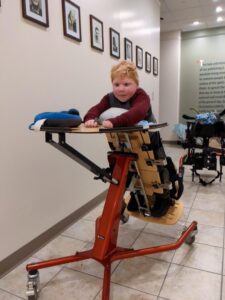
Robert in his stander in October 2022, immediately after a 50-minute session in the Trexo, completing 3000 steps.
Tube Feeding
Robert receives his daily nutrition via tube-feeding. Before the Trexo, he was receiving continuous feeds (a small, steady amount, around-the-clock), but unfortunately Robert was not tolerating this well. He would vomit every few days, despite many attempts to adjust the type and quantity of his feeds. Rob even underwent surgery to alter the style and position of the port and tube itself. Prior to the Trexo, many of Rob’s health issues were related to his feeding. Because of the vomiting, he was not getting adequate nutrition.
Unbelievably, within weeks of using the Trexo, Robert easily tolerated bolus feeding in place of the continuous feed. A bolus is a tube feed given like a meal: a larger amount in a shorter period, with an hours-long break between feeds. In less than a month with the Trexo, and ever since then, Robert receives his nutrition with bolus feeding three meals a day, with a small “snack” before bed. No more overnight feeding! And no more vomiting! Rob is now able to receive twice the amount of food in less time. Robert is receiving all the nutrition he needs, and he has even had a remarkable growth spurt.
Venting
Venting, sometimes called “burping through the G-tube,” is a means of allowing a child’s stomach to get rid of extra air or even residual food. Venting can be done anytime the child shows signs of discomfort, and may need to be done regularly before, during, or after feeding. For Robert, venting has always been a necessary part of life. After two months of using the Trexo, venting with Robert was mostly no longer necessary. And by four months of Trexo use, Rob’s feeding was always with no residual and no venting at all.
Constipation
Before the Trexo, constipation had been a life-long issue for Robert. His daily Trexo walking changed all that. Constipation went from being a significant problem to a non-issue. Robert no longer needs suppositories or enemas, which used to be a regular part of life.
Respiration
Overall, Robert’s respiration has definitely improved. Robert has struggled significantly with respiratory viruses, not infrequently even requiring hospitalization. As a result, Rob’s oxygen levels were being monitored day and night. Since using the Trexo, Robert’s respiratory capacity has improved with better oxygen levels. His parents no longer monitor his oxygen levels during the day, and there is a notable improvement in his oxygen levels while sleeping. His parents have seen a significant reduction in the need for supplemental oxygen. While he can still experience allergies or have to fight off an occasional virus, he has never required hospitalization for a breathing crisis since he has been in the Trexo.
Over-salivation
Rob has always struggled with excessive saliva production. This in turn negatively impacted his respiration due to frequent problems with aspiration. Rob’s parents were considering surgery as he was on the highest levels of medication to control the issue, even receiving Botox injections to the salivary glands. Now, his salivation has normalized. He no longer requires medications for this at all.
Body temperature
Robert had problems with self-regulation of his body temperature. As a result, he required temperature control clothing to assure appropriate body warmth during the day, as well as a heating-air system for his bed at night. Now he no longer uses the warming vest in daytime, and at night the system is set up for cooling for best sleep.
Sleep
With the daily physical activity of Robert’s walking in the Trexo, he sleeps much better at night. There are even nights when he remains asleep for most of the night, which has never happened before.
Blood work
Robert had regular hemotology work-ups to monitor issues with his blood. Since using the Trexo, the results from his blood work have improved significantly.
Endurance and stamina
Robert began sessions in the Trexo for 15-20 minutes, not every day. Now Robert uses the Trexo daily, sometimes for more than an hour. And just this month, he surpassed 200,000 steps in the Trexo.
Quality of life
Robert and his family are excited to share about the Trexo Home and the big difference it has made in improving his overall health, well-being, and quality of life. While all the medical changes have been impressive, the most important aspect for Robert is how the Trexo gives him a chance to interact with his peers. Robert can be present much more in his school and in the community. With his improved head control and his eyes open, Robert can now engage socially with family and friends each day. He vocalizes more, uses more facial expression, and communicates his likes and dislikes. He often smiles in friendship and recognition, and has only rare moments of extreme unhappiness. The Trexo has been life changing for Robert.
————–
In December, 2022, Robert with his siblings visit the factory where their dad works. Look closely and notice that he is walking backwards. Walking backwards helps Robert to stretch out his hip flexors and to improve his neck extensor and postural strength. Robert’s ability to cough has improved as well.
https://photos.app.goo.gl/B6S7vQcaeVcmedPq7
Robert with his friends, January 2023