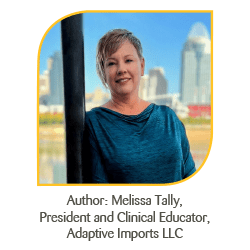
Guest blog by Melissa Tally, PT, MPT, ATP – President and Clinical Educator, Adaptive Imports, LLC
40 stories for 40 years is a great way to celebrate a milestone by looking back at where Jenx started, how far they have come and explore the opportunity of the future.
This is what we do when we come upon certain phases of our lives. I have encountered a bit of a milestone myself. I recently found myself sitting in an auditorium watching my nephew graduate from physical therapy school the same week I had accomplished this 25 years ago. In addition, this year I decided to change direction in my physical therapy career by moving from clinical practice to clinical education. It was an emotional moment and allowed me time to reflect on the last 25 years.
All those years ago, I was so excited and eager to begin treating patients. Right away, I found my dream job working with pediatric patients in a group therapy model. It was a place I had thought I would find after a few years of experience but there I was, day one as a licensed physical therapist. The Cincinnati Children’s Perlman Center presented a model of care that was Family Centered and Multi-disciplinary before it was “cool”. I worked with a team of interdisciplinary professionals (Occupational Therapist, Speech Language Pathologist, Developmental Specialist and Social Worker) treating small groups of early intervention and preschool age children with complex neuromotor disorders. Each clinician brought their own clinical approach and objectives to a developmental enriched curriculum of themed learning. It was basically playing at preschool, but it was therapy, and it was FUN. Our teamwork created an adapted therapeutic preschool environment that allowed our patients to participate, communicate, play, move and learn. They experienced age- appropriate activities and social development with augmented and adapted tools. I learned to provide therapy in this environment by adapting play and helping the children interact through clinical hands-on therapy and then matching adapted equipment to support independence of the child.
The approach of Total Access, Total Mobility and Total Communication for the environment and all activities tailored to each individual child was so successful. This model did not only apply in the program environment but in the Assistive Technology Lab with assessment, trials, and recommendation of equipment from low tech to high tech. The team approach carried over looking at adaptation and external support for all activities throughout meaningful daily tasks from birth through the lifespan.
I learned so much through patient and family experiences. Families shared their grief, their frustration, their hopes, and their joy. Each experience presents differently for every family. It became evident early on in my career that connecting with these families and providing guidance, support and adaptation was critical to not only the success of the child but the whole family. Simply asking them what they needed, what they were feeling and where they were struggling, guided the approach, support, and intervention. In some way and at various stages, they all were grieving the loss of the “typical child”, confusion about diagnosis, worry about finances and day to day struggles with positioning and interacting with their child.
It is awesome that our medical field has caught up to these families and are providing diagnosis and evidenced based support and intervention earlier. Twenty-five years ago, it was not uncommon for diagnosis and referral for therapy to be at 18-24 months of age. We lost so much time, but we met the patient and family where they were and moved forward all while professionally discussing, researching, and planning ways to start earlier.
Learning about the barriers and priorities are where we started. If sleep was the primary issue, we addressed sleep from a sensory, developmental, and positional perspective. Improving connection between parent and child allowed them to see their child not the diagnosis or disability. This impacted the parent-child relationship and the confidence of the parent to be a parent. Educating parents about the diagnosis, what it meant for now and in the future allowed them to see opportunity and hope. Through this support and therapy, they grew to really see their child and take joy in the abilities of their child and plan how to adapt for the disabilities.
The use of equipment plays a huge role for patients and families with complex disorders. A child who cannot communicate verbally learns to access a switch or use nonverbal cues at a very young age. Parents miss these cues without guidance and support impacting the child’s development and parent-child relationship. The evidence and basic child development supports early recommendations of positioning supports and adapted environments. This includes incorporating supported standing at age- appropriate development (9-10 months of age), adapted bath supports for increased safety (babies are slippery when wet!), options for supported sitting and postural positions to allow access for developmental play, interactions, and learning. Adapted Equipment (commercial of adapted) provides opportunity to for the child to meet developmental, postural, and medical needs while also educating and coaching the parent to incorporate these supports into their lives for successful play, participation, and development. In some cases, it is a tool to augment the situation until the child learns to be independent but in most complex neuromotor cases it offers an adaptation to allow them to live and grow across their lifespan.
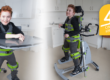
Jenx has been there since the beginning of my career. I learned hands on about standers from a mechanical and technical standpoint with the Monkey and Giraffe. The idea of standing developmentally and clinically was part of child development and the clinical treatment protocol for children with special needs. I was hooked on the benefits of standing on day one! If you have seen the smile on a child’s face, maybe more importantly the tear in a parent’s eye, when the child stands for the first time you know what I mean. My focus on adapted equipment grew from here. I saw how adapted equipment made lives functional and fun, engaged patients with their family, provided opportunity for social emotional growth with friends, builds strength, development, health, and independence and helps provide hope and opportunity for the future.
In the last 10 years the evidenced based approach to adapted equipment to support development and meaningful tasks throughout daily routines has been defined as 24 Postural Management. We have knowledge based best practice guidelines and RESNA positional papers on sitting, standing, lying and standards of care for complex rehab assessment. Jenx has played an important role in the application of 24 Postural Management over the last 40 years. They have been dedicated to supporting children with disabilities in all areas of positioning and development. They designed one of the first standers that could be adjusted to support a 10-month-old child as well as one of the first with an abduction frame. They design supportive equipment for adapted functional ADL seating, external support for supportive posture in lying position and alternative positioning for advanced daily care. Their commitment to quality design of functional products, continued research and education on evidence-based information and their impact on advocacy and access has made them a leader in complex rehab equipment. I am fortunate to have had Jenx available in my physical therapy practice, education, and clinical patient care for the last 25 years and I am excited to be a part of their future in my role as President and Clinical Educator of Adaptive Imports, the distributor of Jenx in the US. The opportunities for growth, awareness, access, and design are countless in improving the lives of our patients and families and LIVING with complex rehab equipment.
About the Author
Melissa Tally is a PT/ATP with 25 years of experience in complex rehab technology with a focus on parent coaching, early intervention and 24-hour postural management. She spent these years at the Cincinnati Children’s Perlman Center, a muti-disciolinary integrated therapy program for patients with complex neuromotor disorders and state of the art assistive technology evaluation center. She began her current role as President and Clinical Educator at Adaptive Imports, LLC in 2023
This blog is part of our 40 stories for 40 years’ series, celebrating our partnerships over the years. Click here to read more blogs in this series.