Written by Kieran Murphy, Clinical Partnerships Manager. 
Two thought-provoking scoping reviews have recently been published in the last couple of months that again highlight the difficulties of ‘gold standard’ research with complex and heterogenous populations and interventions [1,2]. 
A scoping review differs from a systematic review in that it seeks to present an overview of a potentially large and diverse body of literature relating to a broad topic, whereas systematic reviews typically collate a smaller range of quality assessed studies that are relevant to a focused research question [3,4].
A common theme in the conclusions of most systematic reviews pertaining to interventions in postural management and paediatric neurodisability is that there is a ‘lack of robust evidence’, and further research is recommended. The problem here is that the most robust or ‘Gold Standard’ form of evidence, the randomised controlled trial (RCT), is not easily applied methodologically or ethically in the realms of postural management and paediatrics. RCT’s require an intervention to have a degree of uniformity in its application, but postural management and the needs of children with disabilities are not uniform. Postural care practices should be fluid and adaptable, tailored to the unique needs of each child. Postural care often requires a 24-hour approach that includes a large variety of interventions and adaptive devices within this umbrella of care. The wide heterogeneity in interventions and children requiring intervention does not lend itself well to the RCT design. Furthermore, RCT’s require a ‘control’ group who receive no intervention alongside the experimental, a process that would mean withholding potentially beneficial treatment from participants and is ultimately unethical.
Both new reviews highlight these difficulties, alongside issues with blinding researchers or participants and the need for long term follow ups as other major stumbling blocks when conducting the most robust research. This ultimately narrows the pool of evidence available when conducting systematic reviews.
As such, both chose to do a scoping review with broader questions and inclusion criteria. The scoping methodology allows for all relevant literature to be described and synthesized, including clinical guidelines, policies or exploratory research, and can be used to provide a map of evidence to inform practice, help provide clinical reasoning and identify any further gaps in research [3,4]. Below is a summary of the key statements from each article.
‘Supported-standing interventions for children and young adults with non-ambulant cerebral palsy: A scoping review’
https://doi.org/10.1111/dmcn.xxxxx
Lynore McLean, Ginny Paleg and Rosyln Livingstone attempted “to describe the evidence, outcomes, and lived experience of supported standing for children and young adults with cerebral palsy (CP) aged 25 years or younger, classified in Gross Motor Function Classification System levels IV and V” [1].
Previous systematic reviews of supported standing from Paleg and her colleagues have suggested supported standing could positively affect bone mineral density (BMD), hip stability, spasticity, and range of movement [5,6], but evidence is often appraised as moderate to low quality.
This review identifies similar themes, noting body structure impairments are often a primary focus for the impact of supported standing in research. Maintenance of BMD and contracture prevention were outcomes supported by the largest body of experimental evidence. The authors make recommendations that future research should focus on the impact of BMD around the distal femur, as this is thought to be the most common fracture site in non-ambulatory CP [7,8]. 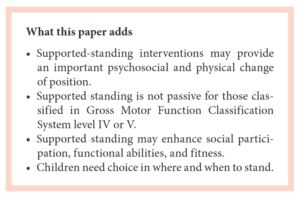 What this paper does also add, is that supported standing should not be viewed as a passive activity for those at GMFCS IV-V. Previous studies have suggested supported standing may increase energy expenditure and accumulate to light physical activity in GMFCS IV and V and may influence muscle activity and cardiovascular fitness in GMFCS IV subjects [9,10]. Particularly with an emerging world-wide focus on 24-hour movement [11], coupled with the challenges of incorporating exercise interventions for individuals with the most severe disabilities, supported standing could be an important intervention for not only change of position, but also for interrupting sedentary behaviour, increasing physical activity and improving sleep.
Standing dosage recommendations vary dependent to outcomes being targeted, remaining similar to previous dosage recommendations [6]. Qualitative data found that 30-60 minutes, 5-7 times per week was the most commonly reported standing duration. The authors do highlight that typical development of pulling to stand and handheld standing is around 8-11 months of age and that reduced muscle growth rate and stiffness occurs in children with CP between 9 and 18 months [12]. They advise this suggests weight bearing and activity may play an important role in reducing stiffness, warranting more research, but also advocating that children at GMFCS IV-V should be supported to start standing between 9 and 12 months of age, which offers a slightly earlier window than the often-cited MacKeith consensus statement from 2006 [13]. Paleg & Livingstone also re-iterated this in their brilliant article providing clinical perspectives on postural management and hip health in non-ambulant CP [14].
Ultimately, prescription of a standing frame and its dosage should be part of a robust individualised assessment of the child’s goals/interests/needs, their support and environment. Collaborative working between therapists, children, carers, and educational staff is vital to successful outcomes and engagement. The child’s voice is also important – children value their choice in the type of frame they use and where and when they stand [15].
Key overarching themes were identified from the ‘lived experience’ evidence similar to these views and they also highlight the positives of standing as viewed by therapists, children and their carers:

The authors conclude that there is still insufficient high-quality studies to warrant a further focused systematic review. They also state that clinical guidelines identified that make recommendations on the use of supported standing frames, including NICE guidelines for management of spasticity in under 19’s, were not sufficient or specific enough for use in clinical practice. They call for a formal consensus process involving standing frame users, families, caregivers, clinicians, and researchers to be undertaken to develop more comprehensive guidelines.
Evidence for 24-hour posture management: A scoping review
https://doi.org/10.1177/03080226221148414
Lauren Osborne, Rosemary Gowran & Jackie Casey similarly performed a scoping review to examine the evidence for 24-hour postural management, whilst also explore provision of postural care within the UK and consider recommendations to improve postural management practice as a whole within the UK Occupational Therapy (OT) profession [2]. Whilst this may include an overview of UK services, the literature and themes identified will be helpful resources and relatable issues for clinicians worldwide.

The authors identified four overarching themes to link back to their primary objectives:
1.Education on Posture Management – the paper identifies through the supporting literature there is a need for further training for healthcare professionals in prescribing postural management equipment and for carers to competently support and position the individuals using the equipment. Multidisciplinary training on postural management in undergraduate university courses is advocated. The authors discuss how Occupational Therapy ‘as a profession should consider
postural care as a pre-requisite [16] and fundamental to occupational performance’. We know OT’s are ideally suited in their skillset and approaches to ‘take the lead’ within what should ideally be an individualised multidisciplinary service, and we as a company can help encourage this further.
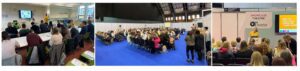
Education on postural management in something Jenx and Jiraffe are passionate about, and there should be a significant onus on adaptive equipment companies to deliver training and support to help support this gap in provision. We have supported in training at universities for OT’s and other MDT professions. We also regularly deliver seminars and workshops both within the UK and globally.
We love to be a part of a supporting a therapist’s journey to becoming a clinical specialist in postural management! Please get in touch for further information via marketing@jenx.com
2. Posture Management across sitting, lying and standing – the benefits of standing reported in Mclean et al’s review are reiterated [1], whilst acknowledging that seating is only one aspect of the 24-hour period and should not be viewed exclusively without considering other postures, particularly postural management in lying.
3. Impact on occupational performance and participation – Whilst standing is not discussed here, the paper highlights the importance of appropriate seating in increasing participation in activities and that sleep is often overlooked as an occupation. Again, the importance of healthy sleep/wake cycle to activity and participation through the day is highlighted.
4.Service Provision – Service provision appears to impacted by disbanding of healthcare services, lack of individualised postural support services, funding and commissioning . Signposting to the Guidance for Postural Care and People with Learning Disabilities, it is recommended that “clincal commisioning groups ensure commision of expert, preventative services with proactive postural care support”[16].
The authors identify that systematic reviews consistently appraise evidence for postural management as weak or low in quality. Alluding to the difficulties in conducting RCT’s previously mentioned, they call for greater credibility to be given to specialist expertise, as much of the literature and evidence sourced in this review is based on this. Again, there is a call for a consensus process to help develop more specific NICE guidelines “to recognise that habitual asymmetric postures can affect any person with complex physical disabilities, all age groups, all positions, and those unable to change their position independently” [2].
Despite this, clinical practice considerations for postural support in lying were produced after a systematic review two rounds of Delphi questioning with members of Posture and Mobility Group UK. Whilst they may be ‘unpublished’ in a scientific journal, they are still available on the PMGUK website and are still an extremely useful resource for clinicians seeking clinical guidance and reasoning for night time positioning: https://www.pmguk.co.uk/data/page_files/Research/Practice%20considerations%20paper%20for%20postural%20support%20in%20lying.pdf
References
- McLean, LJ, Paleg, GS, Livingstone, RW. Supported-standing interventions for children and young adults with non-ambulant cerebral palsy: A scoping review. Dev Med Child Neurol. 2022; 00: 1– 19.
- Osborne LJ, Gowran RJ, Casey J. Evidence for 24-hour posture management: A scoping review. British Journal of Occupational Therapy. 2023;0(0).
- Levac, D., Colquhoun, H. & O’Brien, K.K. Scoping studies: advancing the methodology. Implementation Sci. 5, 69 (2010).
- Pham MT, Rajić A, Greig JD, Sargeant JM, Papadopoulos A, McEwen SA. A scoping review of scoping reviews: advancing the approach and enhancing the consistency. Res Synth Methods. 2014 Dec;5(4):371–85.
- Glickman LB, Geigle PR, Paleg GS. A systematic review of supported standing programs. J Pediatr Rehabil Med. 2010;3(3):197-213.
- Paleg, Ginny S. PT, MPT, DScPT; Smith, Beth A. PT, DPT, PhD; Glickman, Leslie B. PT, PhD. Systematic Review and Evidence-Based Clinical Recommendations for Dosing of Pediatric Supported Standing Programs. Pediatric Physical Therapy 25(3):p 232-247.
- Henderson RC, Lark RK, Gurka MJ, Worley G, Fung EB, Conaway M, Stallings VA, Stevenson RD. Bone density and metabolism in children and adolescents with moderate to severe cerebral palsy. Pediatrics. 2002 Jul;110(1 Pt 1):e5.
- Leet AI, Shirley ED, Barker C, Launay F, Sponseller PD. Treatment of femur fractures in children with cerebral palsy. J Child Orthop. 2009 Aug;3(4):253-8.
- Verschuren, O. et al. Muscle activation and energy-requirements for varying postures in children and adolescents with cerebral palsy. J Pediatr. 2014; 165(5):1011-6.
- Israeli-Mendlovic, H., Mendlovic, J. & Katz-Leurer, M.(2014)Heart rate and heart rate variability parameters at rest, during activity and passive standing among children with cerebral palsy GMFCS IV–V,Developmental Neurorehabilitation,17:6,398-402.
- World Health Organization. 2019. WHO guidelines on physical activity, sedentary behaviour and sleep for children under 5 years of age. Available at: https://www.who.int/publications-detail/guidelines-on-physical-activity-sedentary-behaviour-and-sleep-for-children-under-5-years-of-age. [accessed 05.09.2022].
- Willerslev-Olsen, M., Choe Lund, M., Lorentzen, J., Barber, L., Kofoed-Hansen, M. and Nielsen, J.B. (2018), Impaired muscle growth precedes development of increased stiffness of the triceps surae musculotendinous unit in children with cerebral palsy. Dev Med Child Neurol, 60: 672-679.
- Gericke, T. Postural Management for children with cerebral palsy: consensus statement. Dev Med Child Neurol. 2006; 48(4): 244.
- Paleg, G. & Livingstone, R. Evidence-informed clinical perspectives on postural management for hip health in children and adults with non-ambulant cerebral palsy. Journal of Pediatric Rehabilitation Medicine: An Interdisciplinary Approach Throughout the Lifespan. 2022; 15(1): 39–48.
- Goodwin J., et all. Understanding frames: A qualitative exploration of standing frame use for young people with cerebral palsy in educational settings. Child Care Health Dev. 2019; 45(3):433-439.
- Agustsson A and Jonsdottir G (2018) Chapter 7: Posture management 24/7. In Lange ML and Minkel JL (eds) Seating and Wheeled Mobility: A Clinical Resource Guide. SLACKIncorporated, pp.121–136.
- Public Health England (2018). Postural Care and People with Learning Disabilities: Guidance. Available at: https://www.gov.uk/government/publications/postural-care-services-making-reasonable-adjustments/postural-care-and-people-with-learning-disabilities#fn:6.
About the author – Kieran Murphy
Kieran qualified as a Physiotherpist in 2016 at the University of Salford and later attained an MSc at the same university in Advanced Physiotherapy. He completed his core rotations before becoming a senior paediatric physiotherapist for the NHS in Great Manchester, UK.
Kieran’ s experience as a physiotherapist has seen him provide a wide range of holistic therapy to children with developmental delay, complex neurological and physical disabilities and musculoskeletal injuries. He continues to work alongside his role as Clinical Partnerships Manager for Jenx with a small caseload of private patients and as a locum therapist.
Kieran has a keen interest in supporting adolescents with cerebral palsy and the management of hip dysplasia.
In his spare time Kieran is passionate about football and enjoys fishing.