For children with physical disabilities, weightbearing, physical activity and maintaining postural alignment can be crucial for their overall health, development and participation in daily life. Standing frames can become an invaluable tool in achieving these goals and are associated numerous physical and psychological benefits [1,2]
The International Classification of Functioning, Disability and Health (ICF) is a framework developed by the World Health Organisation in 2001 [3] that shifts emphasis away from the person’s disability or impairment and places focus on the ability of the individual and their individual needs. It is a dynamic and holistic biopsychosocial system which outlines the interaction between the person’s condition and health with personal and social factors, daily activities, and environment.
In 2011, In 2011, Dr. Rosenbaum and Dr. Gorter published a paper titled: “The ‘F-words’ in Childhood Disability: I swear this is how we should think!” [4] The six F-words: Fitness, Function, Friends, Family, Fun and Future, reframe the ICF in a child – centric and family orientated way, whilst still encouraging professionals to look beyond the child’s disability or diagnosis and focus on their ability and development.

In this blog, we will review the use of supported standing frames through the F-Words lens, to show that standing frames are much more than just standing! 
Functioning
An important developmental gross motor milestone for children and their families is being able to stand, but for children with physical disability and developmental delay standing can be challenging, scary and effortful. A standing frame with appropriate support prescribed to the level of the child’s physical ability can help conserve energy, allow movement to occur more easily and repeatedly through the head, trunk and upper limbs, can challenge and develop skill with the influence of gravity or gradual reduction of support, can provide a new viewpoint of world around the child and help with learning and understanding their movement. Standing frames can of course, provide experience and weightbearing that can help with developing independent standing ability in certain children.
Here is a brilliant example of Ava working extremely hard in her Monkey standing frame developing her head control over a period of 6 months:
Family 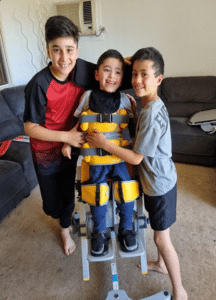
Standing frames can facilitate so much positive experiences and interactions for the family. An important goal for the child’s carers is often to see them stand and have some degree of independence without the physical support of the family. Standing frames can provide an opportunity for a hug with mum, and opportunity to practice baking at the kitchen counter with grandad, an opportunity to play throw and catch with Benjy, the family dog. Standing can facilitate communication between the child and their carers – such as using an eye gaze more effectively with the appropriate supports enabling improved head control.
Standing frames can reduce carer stress and care burden overall through the positive experiences they facilitate, their ease-of-use features and the independence they can give to the child.
In the following video, Emma’s mum explains why she loves the Standz 2:
 Fitness
Supporting standing is associated with a range of physical benefits including improving or maintaining bone mineral density, improving or maintaining range of motion, reducing spasticity or maintaining hip stability. When incorporating supported standing into the child’s daily routine, hobbies and play interests, it is rarely passive and it can provide an important break in prolonged sedentary behaviour. Sedentary behaviour is associated with many negative health outcomes and those with physical disability are more at risk of being sedentary. Some research has suggested people with Cerebral Palsy spend 75-99% of the waking hours being sedentary, so it is extremely important a child with physical disability is given opportunities to move and change position[5]. The term ‘fitness’ also incorporates mental well-being. Children with disabilities are at high risk of experiencing mental health challenges [6], which can be compounded by social isolation, reduced opportunities to move and participate in daily life. Supported standing can easily boost mental well-being by encouraging interaction, inclusion and independence.
Here is Zeke showing just how physically active and fun supported standing can be, practicing his swing ball skills:
Fun
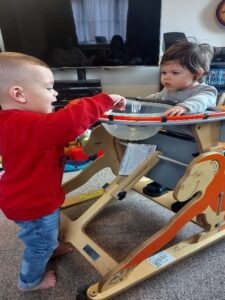
Supported Standing is not just about boring things like stretching and weightbearing. It can encourage messy and sensory play through simple accessories such as tray and bowl. Having an open design and castors on the base of the frame can facilitate exploration of the child’s environment and play in multiple areas just like their friends. It means they can stand and play music at a keyboard, hold on to a rainbow parachute during class games or dance with their siblings. 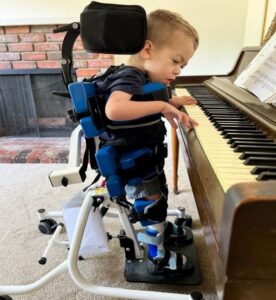
It is important a child is involved in choosing when and where they stand to keep supported standing being fun and orientated to their interests [6].
Ian and his mum show just how fun standing frames can be, as he uses his to play with his toys and play with bubbles!:
 Friends
Standing frames can enable children to stand just like their peers, enabling familiarity with one another and important eye to eye play, interaction and communication. They can facilitate activity and participation in nursery, school and home environments, such as standing for arts and crafts or singing karaoke together.
Here is a lovely video of Marieme and N’Deye joining their friends at school in their standing frame to play and do class work:
Future
Supported standing frames can support physical and cognitive development, can help maintain and improve bodily functions, structures and fitness, can help develop social and familial relationships. Utilizing the F-Words in standing frame prescription throughout the child’s life can ensure they are used as a holistically and family focussed as possible.
Read Madison’s Story here: https://jenx.com/madisons-story-how-supine-stander-helps-with-upright-play-weight-bearing-and-stretching/
References:
- Paleg, G. S., Smith, B. A., & Glickman, L. B. Systematic review and evidence-based clinical recommendations for dosing of pediatric supported standing programs. Pediatric physical therapy : the official publication of the Section on Pediatrics of the American Physical Therapy Association,2013; 25(3), 232–247. https://doi.org/10.1097/PEP.0b013e318299d5e7
- McLean, L. J., Paleg, G. S., & Livingstone, R. W. Supported-standing interventions for children and young adults with non-ambulant cerebral palsy: A scoping review. Developmental medicine and child neurology, 2023; 65(6), 754–772. https://doi.org/10.1111/dmcn.15435
- World Health Organization. (2001) International Classification of Functioning, Disability and Health (ICF). https://www.who.int/standards/classifications/international-classification-of-functioning-disability-and-health
- Rosenbaum P, Gorter JW. The ‘F-words’ in childhood disability: I swear this is how we should think! Child: care, health and development. 2011; 38(4): 457–463. https://doi.org/10.1111/j.1365-2214.2011.01338.x
- Verschuren, O. et al. Exercise and physical activity recommendations for people with cerebral palsy. Dev Med Child Neurol. 2016; 58(8):798-808. https://doi.org/10.1111/dmcn.13053
- Heslon, K., Hanson, J. H., & Ogourtsova, T. (2024). Mental health in children with disabilities and their families: red flags, services’ impact, facilitators, barriers, and proposed solutions. Frontiers in rehabilitation sciences, 5, 1347412. https://doi.org/10.3389/fresc.2024.1347412
- Paleg GS, Williams SA, Livingstone RW. Supported Standing and Supported Stepping Devices for Children with Non-Ambulant Cerebral Palsy: An Interdependence and F-Words Focus. International Journal of Environmental Research and Public Health. 2024; 21(6):669. https://doi.org/10.3390/ijerph21060669#