When considering the application of paediatric therapeutic equipment, companies and clinicians will often discuss, or try to assess, it’s impact on the child’s ‘Quality of Life’ (QoL). But what does QoL mean to the child, their family and carers, and how can we assess or measure it?
Written by Jenx Clinical Partnerships Manager – Kieran Murphy. 
QoL can be a complex and multifaceted concept despite appearing a very simple term. The World Health Organization defines QoL as “an individual’s perception of their position in life in the context of the culture and value systems in which they live and in relation to their goals, expectations, standards and concerns” [1]. QoL encapsulates all aspects of the individual, including their physical, social, emotional, cognitive and psychological functioning and is ‘’therefore affected by physical health, psychological state, personal beliefs, social relationships, and relationship with the environment of a person’’[2].
The ’individual’s perception’ of quality should be the most important factor in an assessment of their well-being, or lack thereof. The individual’s and the clinician’s assessment of what ‘quality of life’ is can often differ significantly [3]. When it comes to children with disabilities, clinicians can often be focussed on their impairments affecting QoL, when that is not necessarily the case from the viewpoint of the child and their carers. Frameworks such as the ICF [4] and F – Words [5] can help shift the focus away from the impairment and help clinicians and equipment manufacturers think about the child’s life in a more holistic manner when considering application of therapeutic equipment. Ultimately, it is the individual’s assessment of their own needs and goals that should be the most important – whether that be from the child’s voice or their carers.
But how can we measure quality of life? Encouraging verbal feedback or constant dialogue with our service users and providing empathic care can help us ascertain this in some way, but it does not necessarily provide us with something measurable that can be used to show progression and improvement and can be incorporated into goal – setting. Use of individual reported questionnaires is a common method, and providing a numerical scoring system alongside the questionnaire can help us find a measurable figure. There are many versions of quality of life questionnaires covering many different aspects within the world of paediatrics, and often these questionnaires have license and purchasing fees.
At Jenx, we wanted to create a quality of life questionnaire that could be completed with our younger product users. We feel it is essential that we provide support to try and capture the child’s voice and feedback, as they are the most important people to us, and it is their voice that should be paramount to therapeutic equipment prescription and evaluation. We wanted the questionnaire to consider the key areas of the ICF/F-Words, whilst also drawing on other aspects of other paediatric tools to try make the questionnaire as accessible as possible.
Introducing the Jenx Quality of life Measure (JQoL):
Click here to register and download the JQoL for free.
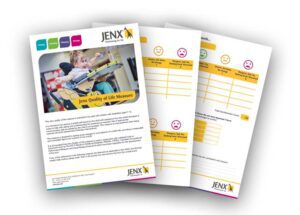
This quality of life measure is a free to use questionnaire intended to be used with children with disabilities aged 7-12. It is intended to be used as a simple self-report by the child with assistance from the child’s therapist or carers to help with asking and understanding the questions as required. Use of appropriate communicative aids as needed by the child is encouraged. This measure is most pertinent when being used pre and post assessment of therapy interventions.
The measure is designed to assess acute changes to core aspects of a child’s life, providing a measurable and numerable figure over a period of one month. The questionnaire consists of 5 sections with 5 questions in each section. Total score is out of 50, and higher scores could indicate better health-related quality of life.
The measure can be completed in one sitting, or over a number of days, it should be utilised in accordance with the child’s needs and functioning.
It is encouraged that JQoL measure is used in conjunction with validated tools or framework such as the ICF, F-Words in Childhood Disability, PEDsQL, CPQOL, Canadian Occupational Performance Measure and Visual Analog Scale all of which have been inspiration for the development of this tool.
We understand development of a new measure should be a fluid process, as such we would appreciate any feedback/comments on how we can improve this questionnaire or make it more accessible. We would also love to see the questionnaire in use with our products and see first hand how the products are impacting the lives of the children we support.
We have also produced a ‘read-easy’ version of the JQoL with larger text, one section per page and handy cut out ‘mood’ faces to support answering the questions. If you would prefer access to this version or you have feedback or case studies with the questionnaire in use please contact: marketing@jiraffe.org.uk
We are hoping to create a questionnaire for teens and for carers in the near future, so watch this space!
Many thanks to the therapy teams in Greater Manchester, the National Deaf Society and our colleagues at Medifab and Rifton for their feedback during the development of this questionnaire.
References
[1] World Health Organization. WHOQOL: Measuring Quality of Life. Retrieved 12/12/22 from https://www.who.int/tools/whoqol
[2] Ali, U. et al. Assessing the Quality of Life of Parents of Children With Disabilities Using WHOQoL BREF During COVID-19 Pandemic. Front Rehabil Sci. 2021; (2):708657.
[3] Janse, A.J. et al. Quality of life: patients and doctors don’t always agree: a meta-analysis. J Clin Epidemiol. 2004;57(7):653-61.
[4] World Health Organization. (2001) International Classification of Functioning,
Disability and Health (ICF)
[5] Rosenbaum, P. & Gorter J. The ‘F-words’ in childhood disability: I swear this is how we should think! Child: care, health and development. 2011; 38(4): 457–463.
About the author – Kieran Murphy
Kieran qualified as a Physiotherpist in 2016 at the University of Salford and later attained an MSc at the same university in Advanced Physiotherapy. He completed his core rotations before becoming a senior paediatric physiotherapist for the NHS in Great Manchester, UK.
Kieran’ s experience as a physiotherapist has seen him provide a wide range of holistic therapy to children with developmental delay, complex neurological and physical disabilities and musculoskeletal injuries. He continues to work alongside his role as Clinical Partnerships Manager for Jenx with a small caseload of private patients and as a locum therapist.
Kieran has a keen interest in supporting adolescents with cerebral palsy and the management of hip dysplasia.
In his spare time Kieran is passionate about football and enjoys fishing.