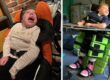
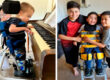
As part of our 40 stories for 40 years blog series, we’re sharing Adeline’s story, who is able to sit and play with greater independence in the Jenx Corner Seat.
Adeline is a bright ray of sunshine!
She is two years old, and lives in Melbourne, Australia with her mum and dad. She adores her two puppy dogs and likes taking them on their walkies. She is a groovy dancer and loves to dance with her mum at home. She is always smiling and is a big fan of Elmo.
Adeline has Dyskinetic Cerebral Palsy. She is affected by generalised dystonia, which is characterised by involuntary contractions throughout her body triggered by attempts to move. Adeline is supported with 24-hour care by her loving parents, who create an extremely enriched environment for her during such a critical period of her development. Her days involve lots of play and therapy – and her adaptive equipment is integral in supporting this.
Adeline is still working hard on her sitting ability, and finding an early option for seating that is comfortable and supportive, yet still enables freedom of movement has been challenging. Mum Lauren says:
“Adeline is so uncomfortable in seating. She is very attached to Mummy and she has become very used to my physical support. It has been difficult to find an appropriate support where she is happy to play independently and not be in my arms”.
Luckily, there has been support from a seat more recently that has eased the care burden for mum and enabled opportunities for independent play and interaction with the world around her for Adeline – the Jenx Corner Seat!
 The Corner Seat provides simple support that adjusts easily to Adeline’s developing posture and helps maintain a stable seated posture for short periods of time. Its open design allows for freedom of movement in her upper and lower limbs but it is still sturdy enough to support her dystonic movements without loss of stability. It has a small footprint suitable for the home or nursery settings. It can easily be placed to suit the situation or context – such as floor based play with peers, or kitchen counter height to help mum with the cooking!
The immersive seat base is perfect for supporting long sitting, a typical variation in sitting position in early years development that also provides a sustained stretch to her spastic hamstring muscles. The angled wings and adjustable back height provide lateral support at the pelvis, trunk and head and accommodates growth. The pommel helps provide a gentle stretch to higher tone adductor muscles, helps increase base of support and provides gentle abduction and external rotation positioning that may be of benefit to Adeline’s hip health and stability [1].
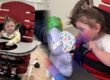
Most importantly, Adeline is now comfortable enough to sit in her Corner Seat for extended periods of time and the support it provides means she can now play and practice repeated tasks essential to her development more independently. Recent international clinical practice guidelines for early intervention practices in Cerebral Palsy have advocated the importance of repeated, task specific motor training and enriched environments to take advantage of children’s remarkable neuroplasticity and aptitude for learning [2]. It’s so important to remember that adaptive equipment like the Corner Seat can encourage this learning. For example, here is Adeline, working hard on her communication skills with her mum whilst in her Corner Seat. Lauren says:
“Adeline now sits in her Corner Seat for longer periods and appears happy and comfortable. This degree of independence for her has also given me more time to do things around the house and given me reassurance that Adeline can sit and play safely”.
Adeline, Jenx Corner Seat and the ICF/F-Words (3,4):
- Fitness – The Corner Seat enables prolonged stretching of spastic muscles and my aid prevention of postural deformities and contractures. It helps Adeline sit with reduced energy expenditure and encourages active sitting for building of stamina and reducing fatigue.
- Function – The immersive seat base, adjustable pommel, supportive trunk and pelvic straps and lateral support from the rear wings ensure optimal early support at the appropriate segmental level of control. This encourages development of Adeline’s head and upper limb control for exploration of her environment, learning and skill development.
- Friends – The corner seat encourages active floor-based play and interaction with Adeline’s peers, and can easily be transported into the nursery environment.
- Family – Parents now have more reassurance that Adeline can sit and play safely, and the Corner Seat frees up more time for Mum to do other things at home. The corner seat also helps with supporting family play and interaction, freeing up Mum’s hands so she can stimulate Adeline in other ways – such as practicing her communication skills.
- Fun – The enriched environment Adeline has at home is full of play and love. With the Corner Seat, Adeline currently has optimal sitting support for short periods to practice use of her limbs and develop her head control when interacting and playing with her family and friends.
- Future – The Corner Seat will grow with Adeline and will provide a gentle introduction to adaptive seating whilst her skills are developing. It will hopefully help Adeline become more comfortable with other adaptive seating supports so she can sit and play for longer periods and be supported optimally as she grows.
Click here to download Adeline’s Case Study
References
1) McClean, L; Magnuson, S; Gasior, S (2014). Positioning for hip health: A clinical resource, Sunny Hill Health Centre for children, Vancouver, BC, Canada.
2) Morgan, C. et al (2021). Early Intervention for Children Aged 0 to 2 Years With or at High Risk of Cerebral Palsy: International Clinical Practice Guideline Based on Systematic Reviews, JAMA Paediatrics. 175(8): 846–858.
3) World Health Organization. (2001) International Classification of Functioning, Disability and Health (ICF).
4) Rosenbaum, P. & Gorter J. (2011) The ‘F-words’ in childhood disability: I swear this is how we should think! Child: care, health and development. 38(4): 457–46.
This blog is part of our 40 stories for 40 years’ series, celebrating our partnerships over the years. Click here to read more blogs in this series.