Meet Lucas
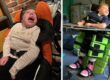
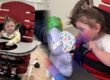
Lucas lives in Australia with his Mum, Dad and two brothers. He is the youngest child and loves watching the Wiggles and playing with his toys. His mum Jennie says, he “is always just full of joy and happiness”!
Lucas has a rare genetic epilepsy disorder called KCN2Q Encephalopathy: https://www.kcnq2cure.org/kcnq2-epilepsy/
He is affected by seizures, his first seizure occurring when he was just one day old, hypotonia, fatigue and developmental delay. Lucas has difficulties with his motor skills and is non-verbal. When he was an infant, he was unable to sit without significant support. Jennie describes a small portion of the difficulties they faced as a family:
“When Lucas was 8 months old… he wasn’t able to sit unsupported. I couldn’t put him in a bouncer or put him in a normal high chair to feed him, because he was a floppy child and he would ‘flop’ over the chair”
But Lucas isn’t defined by his disability, and he is showing the world that with the right support in place he can develop all his skills. With the loving support of his family and the professionals around him, and a little bit a facilitation from assistive technology, he is now making brilliant progress with his sitting ability and other functions. 
One of his helpers during his development has been the Jenx Atom chair!:
The Atom and Lucas began their journey together when he was 8 months old. This is an age when his neurodevelopment should be at its most prolific and should be shaped by experience and exploration of the world around him. Being unable to sit up unsupported severely limits the interaction with his environment and may have caused further developmental delay.
‘The acquisition of new motor skills creates new opportunities for learning. Infants’ new-found ability to sit independently, for example, frees their arms so they can reach, grasp, and manually explore objects…… the acquisition of skills for manual exploration of objects facilitates increased attention to objects and object perception and understanding’ [1]
American clinical guidelines for children with central hypotonia encourage early interventions supporting children to sit with optimal support with adaptive seating that can provide opportunities for play, reaching and grasping [2] and this can maximise their functional and cognitive outcomes.
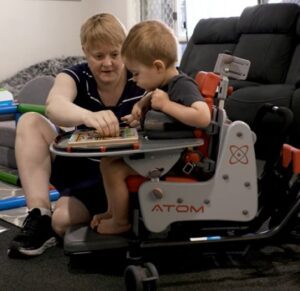
The Atom – with features such as the lap strap, adjustable seat, back and footplate – provided the optimal support to meet Lucas’s needs perfectly. It could also grow with him, and being tool-free it could quickly and easily be adjusted to challenge and develop his skills further. He could now sit in a more stable and symmetrical position that reduced his energy expenditure and allowed him to participate more in playtime and daily activities with more purposeful movement.
Hear mum Jennie’s thoughts on how the Atom has positively impacted Lucas’s daily life: Lucas’s Story – Medifab AUS : Medifab AUS
Here are some other features of the Atom that are essential to Lucas’s daily routine and development:
The high-low base on the Atom can enable floor-based or table-height activities, such as playing with puzzles with mum or eating dinner with the rest of the family.

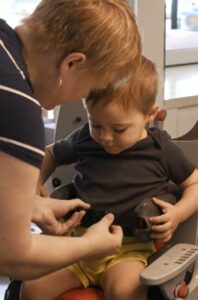 The flexi-thoracics provide comfortable and sturdy support around the trunk, at the appropriate segmental level of trunk control for Lucas’s ability, allowing him to focus on his upper limb use and head control. The thoracic supports are also easily adjustable in height and width, with a flip away mechanism that can help challenge and develop postural control and ability further.
Jennie says: “The lateral supports help him sit up, and when he is more supported at his trunk he is able to use his hands to do fine motor practice, such as being able to pick up food and self-feed”
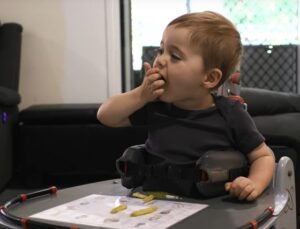
The Atom tray is easily removed and replaced to adjust to Lucas’s environment and individual needs for activities. It is great for holding toys to encourage play and it is also perfect for attaching communication aids so Lucas can develop his communication alongside his physical skills.
Lucas, Atom, and the F-Words [3]
Fitness – The Atom provides optimal support to create a stable and symmetrical posture that allows for reduced energy expenditure and helps avoid prolonged ‘destructive’ postures that may affect internal functioning and lead to musculoskeletal abnormalities. It encourages active sitting and play that also helped build Lucas’s stamina and reduce his fatigue.
Functioning – The support and adjustability of the Atom encourages development of postural control and motor skills. Lucas needed significant support to sit when he first started using the Atom, but over the time the support was reduced. Support at the trunk and pelvis allowed Lucas to focus on his upper limb and fine motor skills – improving his ability to play with toys and self-feed.
Friends – The Atom enabled Lucas to experience movement and positioning like his typically developing peers. It can encourage floor-based play or play at table height with friends and its adaptability encourages further progression in development so he can participate in more activities with friends.
Family – The compact size and mobile base of the Atom means it easily fits into the home environment and can easily be moved from room to room. It can be used for play, therapy or feeding. It’s ease of use, tool free features and wipe clean surfaces help ensure the care burden associated with its use is kept to a minimum. The large tray is a great surface for Lucas’s communication sheet and allows for him to continue to practice his communication skills with his family whilst sat in the Atom.
Fun – The Atom tray can hold some of Lucas’s favourite toys and puzzles at playtime. Lucas’s mum feels the Atom has been pivotal for enabling him to join in more with fun family activities at home.
The Future
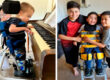
Lucas has continued to progress with his physical skills, so much so, he no longer requires the postural support of the Atom!
The Atom was side by side with Lucas over the last 3 years, complementing his therapy and daily routines, and its adjustability helped support his development.
An aspect of Lucas’s future therapy is continuing to develop his balance and energy levels, but he does so now in more simple adaptive seating to match his fantastic progress! Lucas is now working hard on his walking ability. 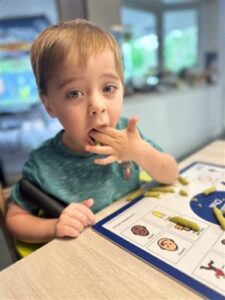
Lucas’s mum Jennie has provided the following brilliant update:
“Lucas has actually made big gains with Physio so he doesn’t need the Atom anymore. We donated it recently to Giveability, to let another person in need use it.
The Atom was life changing when we got it and used every day for 3 years!”
Click here to download Lucas’ Case Study
References
[1] Harbourne, R.T. & Berger, S. Embodied Cognition in Practice: Exploring Effects of a Motor-Based Problem-Solving Intervention, Physical Therapy, 2019; 99(6): Pages 786–796.
[2] Paleg, G., Livingstone, R., Rodby-Bousquet, E., Story, M & Maitre N. Central Hypotonia. Milwaukee: AACPDM; 2019.
[3] Rosenbaum, P. & Gorter, J. The ‘F-words’ in childhood disability: I swear this is how we should think! Child: care, health and development. 2011; 38(4): 457–463.
This blog is part of our 40 stories for 40 years’ series, celebrating our partnerships over the years. Click here to read more blogs in this series.