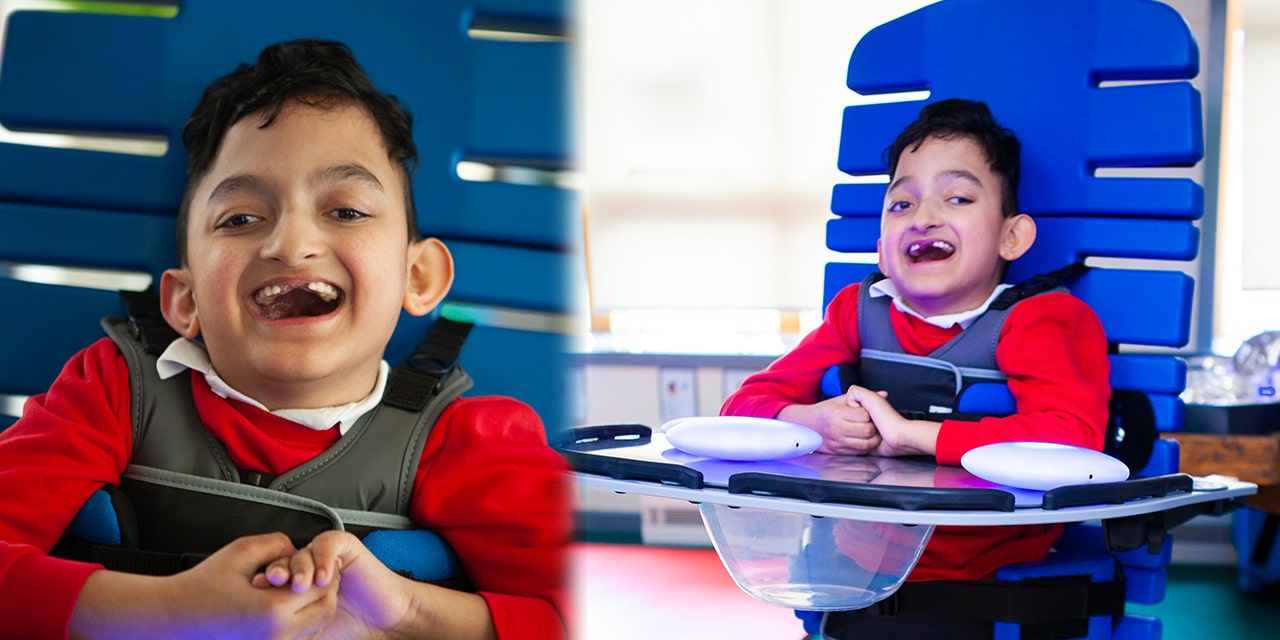
Meet Zain, our Supine Stander super star! The 11-year-old, who lives in Rochdale, has a cheeky personality and a wonderful smile that lights up the room. Zain loves playing with toys, especially if they’ve got flashing lights and play music!
He also loves going to school. He currently attends Spring Side School where he has lots of friends. Zain particularly enjoys standing with his friends and playing with them. However, he is affected by entire body weakness and he struggles to stand without significant help.
Standing is physically tiring for Zain
It can also be scary too. Fortunately, he has been able to stand with the help of our Supine Stander 1 and 2, which has provided him with the head-to-toe support he needs up until now.
But now that he is getting older, Zain is getting taller, which means he has outgrown the Supine Stander 2 and is now using our Supine Stander 3.
The Supine Stander 3 has instantly made a positive difference
Zain is taking part in all sorts of different activities. He is also seeing the world from a different height, as well as enhancing his body, inside and out, in so many ways.
“It improves bone density, provides muscles with a good stretch and helps with respiration and digestion, explains his physiotherapist, Linsie.
“It also helps him socially; Zain can be at the level of his peers and interact with them. He can join in with circle time, and he enjoys using the tray and bowl for messy play.”
More significantly, Zain has been able to give his mum, Farzana, a standing cuddle for the very first time
“I’m very happy for Zain. Normally I don’t see him standing up at home and today I can hug him, normally I can’t hug him,” she explains.
Let’s take a closer look at some of the key features of the Supine Stander and how it’s helping Zain…
The removable accessories means transferring Zain is a seamless process
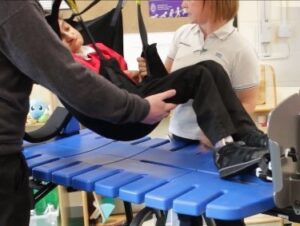
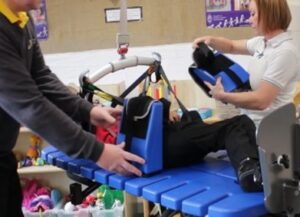
Zain is hoisted for all of his transfers. Transferring a child into a standing frame can sometimes be a complicated process. It can potentially cause distress and use up the child’s energy before they even get chance to stand.
The accessories on the Supine Stander can be completely removed, making it open and uncluttered for transfers.
Zain is hoisted smoothly and safely from his chair on to the stander, which provides full contact with the back of his body via immersive and comfortable polyurethane boards. This comprehensive sensory feedback helps him feel safe and relaxed.
The accessories can easily be replaced via tool-free methods and precisely positioned around Zain’s posture for optimal support and functioning.
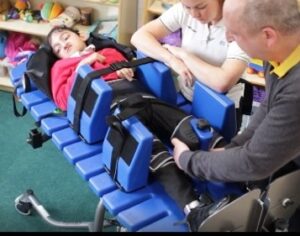
The electronic functionality takes Zain from horizontal to standing in seconds
The process is smooth and controlled, which gives Zain time to adjust to the new position. The standing frame is positioned just off fully upright, enabling Zain to beneficially use gravity to keep his head up for playing and learning.
The head pad cushion and side supports help with his head control and finding a midline position.
Zain also uses a waistcoat harness, which provides further sensory feedback to the front of his body and helps his trunk positioning and control. This, along with the gentle hugging of flexible thoracic support pads, allows him to use his arms more freely and play with toys and sensory blankets on his tray. He loves throwing his blankets on the floor and making a mess! 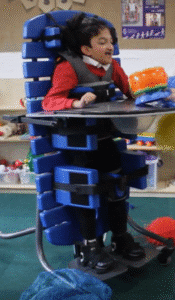
Meanwhile, the flexion knee supports, arched foam pads and abduction block all work together to reduce Zain’s wind sweeping lower limb posture and support his legs, making sure they are comfortable, correctly aligned and optimally weight-bearing.
The Supine Stander 3 means Zain is at the correct height to work and play
“The standing frame gives him the opportunity to access his activities, which include working on our big interactive whiteboard, which he absolutely loves,” explains Zain’s teacher, Becky.
“It also means he is at the correct height to play and work. Zain likes standing with his friends at the same height, he becomes more animated when he is standing. If there are a couple of them standing together doing messy activities, he loves the opportunity to splat his friends with some paint or shaving foam!”
Zain, our Supine Stander and the F- Words (1,2):
Fitness – supported standing with the Supine Stander can potentially positively impact Zain’s bone health, range of motion or digestion amongst many other bodily benefits. It is perfect for positional changes, encouraging physical activity and reducing sedentary behaviour that children with immobility are greatly at risk of. It also boosts mental wellbeing – Zain loves standing and interacting in class and is always happy in his frame.
Functioning – the comprehensive and easily adjustable support of the Supine Stander encourages Zain to work on his head control and use his upper limbs more effectively for play and interacting.
Friends – the Supine Stander encourages eye-level peer interaction. Zain can join in circle time and take part in fun messy play with his friends as they all stand together.
Family – a standing frame can help strengthen family bonds and reduce worry. Zain’s mum has been able to give her son a standing hug for the first time. She was extremely pleased to see Zain comfortable and happy in his stander.
Fun – a standing frame opens up a whole new world of fun! Zain can play with his favourite toys in different ways. He can get messy and explore different textures with the simple addition of the bowl. And he can stand and interact with the class whiteboard much more easily for fun learning.
Future – thanks to its adjustability, the Supine Stander will grow with Zain over the years and can be easily adapted should his skills or posture change. The Supine Stander will continue to support Zain right through high school.
For more information about the Supine Stander 1, 2 or 3 or to discuss your requirements with us, complete this short form and we will be in touch.
1) World Health Organization. (2001) International Classification of Functioning, Disability and Health (ICF).
2) Rosenbaum, P. & Gorter J. The ‘F-words’ in childhood disability: I swear this is how we should think! Child: care, health and development. 2011; 38(4): 457–46